
Google vs. ChatGPT: How Switzerland will search in 2025
Google vs. ChatGPT: How Switzerland will search in 2025
AI-powered tools such as ChatGPT, Gemini and Claude have long since become part of everyday life. Younger users in particular are increasingly turning to digital assistants when it comes to researching information, preparing purchasing decisions or creating content.
But how pronounced is this change in Switzerland? And what are the consequences for SEO and content strategies? To get to the bottom of these questions, we conducted a survey of 312 people in German-speaking Switzerland.
[[callout]] The most important points: in brief
- 50% of respondents prefer AI tools such as ChatGPT to traditional search engines – among those under 30, the figure is as high as 66%.
- 44% use AI tools daily or more frequently, especially for research, text creation and idea generation.
- Google remains relevant, especially for local, current or transactional searches.
- This means that companies need to take action – on a technical, content and analytical level.
[[callout end]]
Procedure
The survey was conducted in April 2025. A total of 312 people from German-speaking Switzerland took part. The sample is not classically representative, as younger, digitally savvy people are overrepresented. However, it is precisely this target group that is at the centre of change and provides valuable insights into how search behaviour is already changing today.
Insight 1: Younger people use AI, older people stick with Google
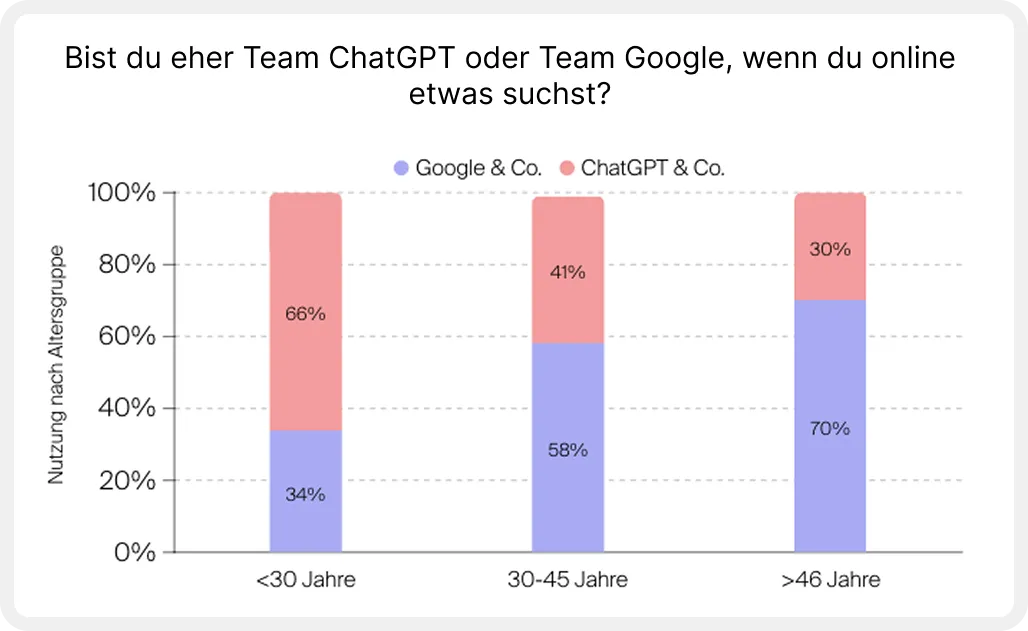
Switzerland is divided when it comes to search behaviour: 50% continue to rely on Google, while the other half already prefer AI tools such as ChatGPT.
A closer look reveals how strongly preferences differ between age groups: two-thirds of those under 30 prefer ChatGPT to Google. In the middle age group, Google remains the leader with 58%, but 41% already prefer AI tools. Among those over 45, Google continues to dominate with around 70%.
This shows that while older people still clearly rely on Google, the behaviour of younger people is already shifting significantly towards AI.
But it's not just age that plays a role; the industry also has a significant influence on usage. To find out how intensively our own target group already works with digital assistants, we conducted a short survey among digital marketers at the beginning of 2025 and published the results in a LinkedIn post. The result: 75% of respondents said they use tools such as ChatGPT daily or even several times a day.
Insight 2: AI is becoming routine, especially for creative tasks
Already 42% of respondents use AI tools daily or several times a day. Applications such as ChatGPT have long been part of everyday digital life, especially among the younger target group: 55% of those under 30 use them daily or more frequently. Among those over 46, however, the figure is only 28%, and a quarter have never used such tools.

Insight 3: AI tools are more than just a substitute for search engines
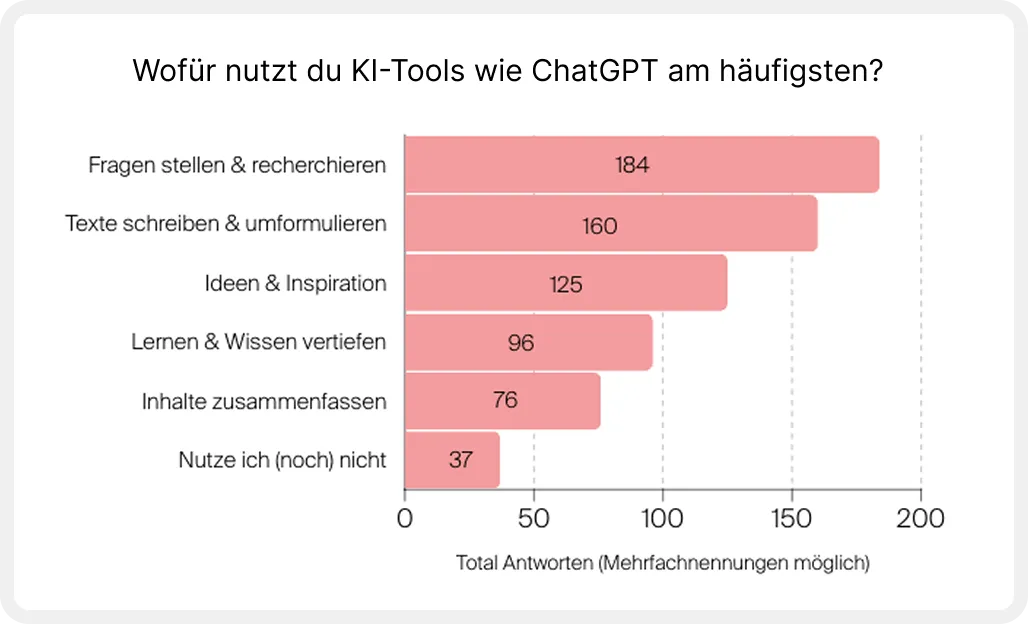
According to the survey, AI tools are primarily used for the following tasks:
- Searching for and researching information
- Writing or revising texts
- Developing Ideas and structuring thoughts
There are hardly any differences between the age groups.
This confirms what we already know from other studies: according to a study by Semrush, only 30% of search queries on ChatGPT follow classic patterns such as information retrieval, navigation or transactions. The majority are creative, dialogical or exploratory. This fundamentally changes the role of search engines. It is no longer just answers that are in demand, but genuine conversation partners and co-thinkers.
Insight 4: Google remains relevant, especially for local and transactional queries
AI is on the rise. However, Google remains the first port of call in many situations – especially for product searches, local information, current news and comparing different sources. Users appreciate the wide variety of information, up-to-date content and clear presentation of search results.

At the same time, AI-supported tools are catching up in these areas too and constantly improving usability. Since the end of April 2025, ChatGPT has been answering questions with purchase intent by providing a selection of products, including details and shop links. So things remain exciting.
{{blog-cta}}
Conclusion
The findings show that AI tools are not yet replacing Google, but they are already noticeably changing search behaviour. Younger people in particular have already changed their research habits, and older users are also increasingly integrating AI into their everyday lives. This creates a new, relevant source of traffic for businesses. Those who want to benefit from this should ensure that their SEO and content strategy is aligned accordingly.
What you can do now
1. Make your content LLM-friendly
Ensure that your website is technically structured in such a way that AI systems such as ChatGPT can easily capture your content: avoid unnecessary JavaScript, use clean HTML code, maintain up-to-date sitemaps and use structured data.
2. Understand your customers' search behaviour
Go beyond traditional keyword research: find out where your customers get their information, what questions they ask themselves at each stage of the customer journey, and how they make decisions – for example, through interviews, user feedback, or qualitative research.
3. Write content that delivers real added value
Write clear, helpful content instead of generic ‘copycat content’. Focus on product-led content that shows how your products and services solve specific problems along the customer journey and how they differ from the competition. This convinces both people and LLMs.
4. Become the voice of your industry
Position yourself as a voice in your industry with thought leadership content – for example, with your own studies, benchmarks or experience reports. Content with substance and a clear stance creates trust and is also picked up and cited more frequently by AI systems.
An example: At the end of 2024, we published a study on domain strategy and distributed it via LinkedIn. It received several high-quality backlinks and was even discussed in a podcast.
5. Rethink KPIs
Instead of just chasing clicks or visibility, ask yourself: Does your content appear in AI responses? Does it support decisions, generate leads and strengthen your brand? Because impact beats reach.
[[callout]]
Bonus Tip:
If you want to know how much traffic your website is already generating via AI tools, you can use our free Lookerstudio template.
[[callout end]]
