.ch or .com: Which domain strategy is better? We analysed 3,200 search results.
.ch or .com: Which domain strategy is better? We analysed 3,200 search results.
Choosing the right domain extension is a crucial factor for success in Google searches. Our analysis of 3,200 search results shows that the .ch domain is the right choice for companies that operate primarily in Switzerland. This is despite the fact that .com domains often dominate search results.
About this study
Every year, we advise dozens of customers on domain strategies, with the choice of the right top-level domain (TLD) often being a key issue. Google has also repeatedly emphasised the importance of the right domain and explicitly mentioned that country-specific domain extensions, known as country code top-level domains (ccTLDs) such as .ch for Switzerland, offer a clear ranking advantage in the respective country.
But what is really behind this? Based on an analysis of 3,200 search results for keywords from the IT services industry, we investigated how the choice of domain extension affects SEO performance. Our study shows how different TLDs influence Google rankings and how Swiss companies can increase their visibility in Google by carefully choosing their domain extension.
The most important facts: in brief
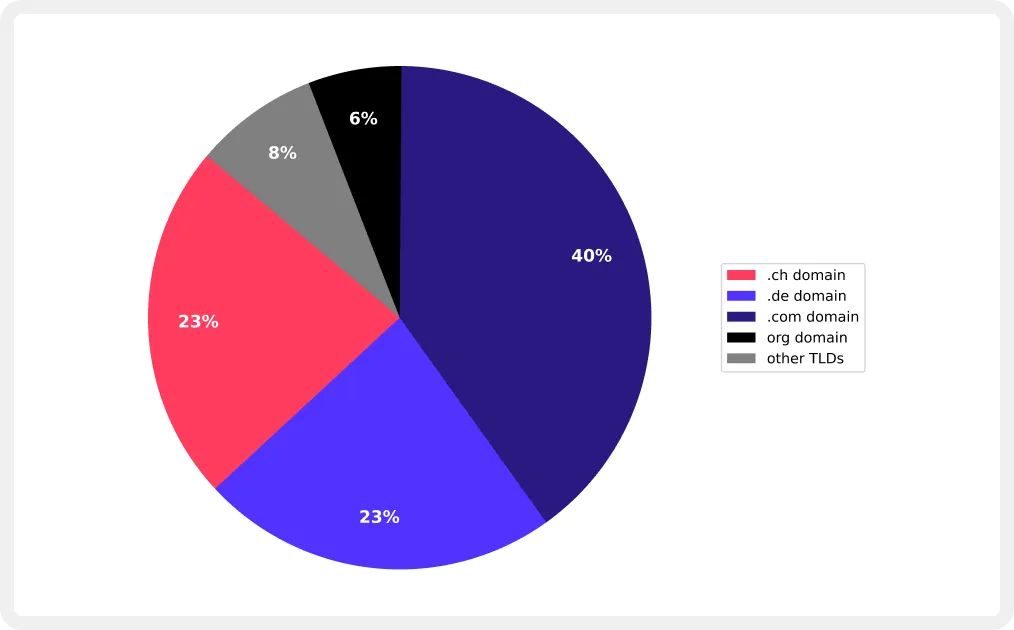
- .com domains lead Swiss search results: With 40% of the top 10 results: .com domains are the most strongly represented. This shows that global TLDs are also successful in Switzerland.
- Non-.ch domains dominate informational search queries: International domains perform significantly better for knowledge-based keywords, while .ch domains lag behind.
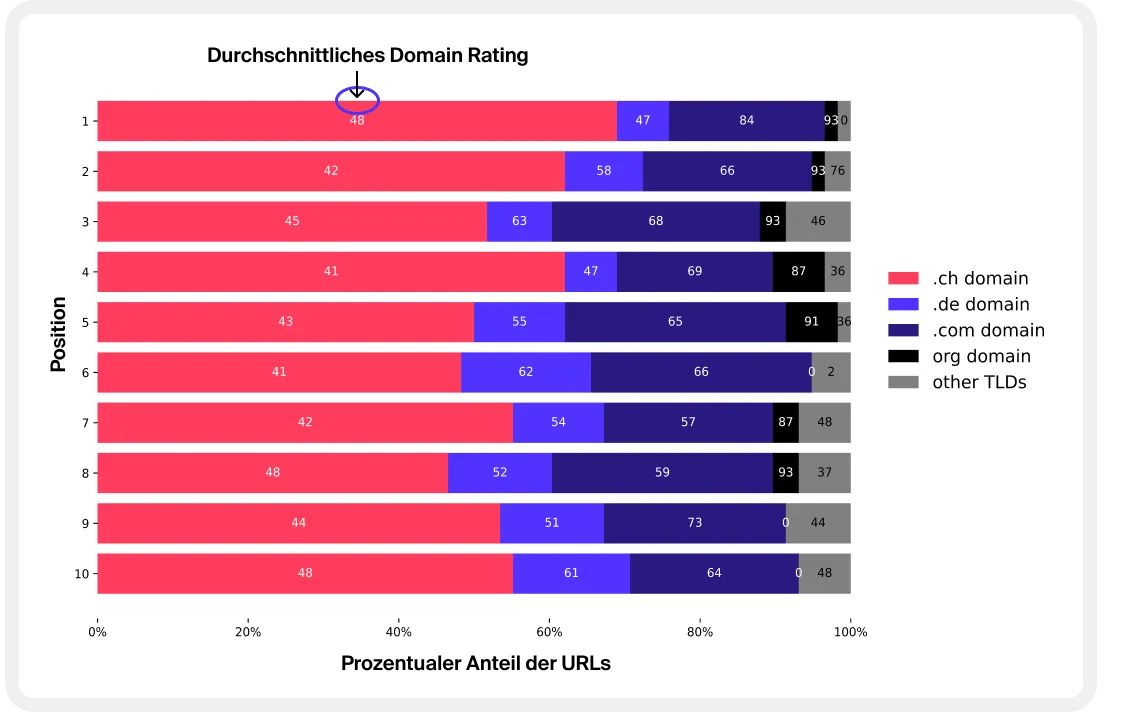
- .ch domains dominate transactional searches: for keywords with purchase intent, .ch domains secure 55% of the top 10 rankings.
- Swiss domains score well despite lower domain ratings: for the same keywords, Swiss domains need an average of 25% lower domain ratings than gTLDs and foreign ccTLDs to rank well.
Introduction
The question of whether country-specific domains (ccTLDs) such as .ch in Switzerland have a clear ranking advantage over generic domains (gTLDs) such as .com is a recurring topic of discussion in the SEO community. Just recently, Google analyst Gary Illyes took a clear stance on this issue in an episode of the podcast ‘Google SEO office hours’:
One user asked:
„When someone in Korea searches in Korean, does a .kr domain rank higher than a .com domain?“
Gary Illyes answered:
„In general, local domain names, in this case .kr, perform better because Google favours content that is locally relevant to the user.“
This statement motivated us to conduct a comprehensive investigation. We wanted to find out whether country-specific domains such as .ch actually have an advantage in Switzerland – or whether gTLDs and other ccTLDs compete with them.
To this end, we examined the influence of the domain extension on Google rankings for 3,200 search results for keywords from the IT services industry.
Proceed
As we serve many customers in the IT services sector, it is particularly exciting and helpful for us to gain insights specific to this industry. We have therefore focused our analysis solely on keywords from the IT services sector. This focus also allows us to reduce distortions caused by an overly broad keyword set and ensure that the analysis provides realistic insights.
Choice of Keywords
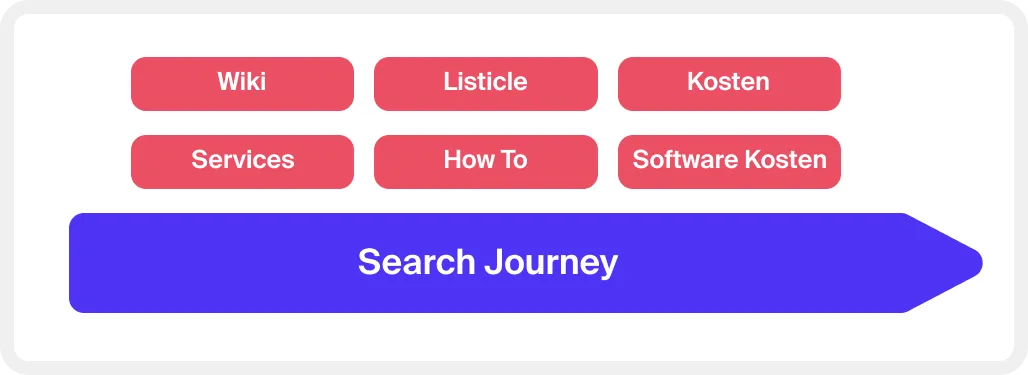
In total, we identified 320 keywords with a monthly search volume of at least 10. This minimum threshold ensures that the selected keywords have sufficient demand and provide relevant data. Another important criterion was that the keywords represent different phases of the search journey (see illustration). This ensures that our analysis covers both informative and transaction-oriented search queries. We divided the keywords into six categories according to their primary search intent: wiki, how-to, listicle, costs, software costs and service providers.
Data Collection
In order to obtain sufficient relevant data, we recorded the top 10 results on Google.co.uk in Switzerland for each selected keyword, resulting in a total of 3,200 data points. In addition, we determined the domain rating of each ranking domain using the ‘Ahrefs’ tool in order to evaluate the authority of the respective websites.
Data Analysis
Finally, we evaluated the collected data using descriptive statistics. This means that we summarised the data points by calculating mean values and deviations in order to represent the distribution of the data and identify typical patterns. This enabled us to find out whether Swiss domains actually rank disproportionately well.
Reason for the methodology: Since search engine optimisation is influenced by many elusive factors, we deliberately avoided using statistical calculation methods in our study. Instead, we relied on descriptive statistics to identify meaningful patterns and trends without determining causal relationships.
The results of the study therefore only show trends and have no statistical significance. Nevertheless, the study offers valuable insights into general developments and correlations between the choice of top-level domains and SEO performance.
Limitations
Although our study provides important insights into the SEO performance of top-level domains, there are some limitations to consider:
- Industry focus: The results are based on the IT services industry and may not be transferable to other industries.
- Limited keyword set: The selected keyword set is not exhaustive and does not cover all possible search queries.
- Market-specific: The analysis focuses on the Swiss market, which is why the results may differ in other countries.
- Snapshot: Google search results are dynamic and constantly changing. Our analysis therefore only represents a snapshot, and trends may change over time.
.com domains dominate Swiss top 10 search results
.com domains clearly dominate the Swiss top 10 search results, accounting for 40% of the total. .ch and .de domains are equally represented, each accounting for 23%. This means that .ch domains account for just under a quarter of the results. This trend illustrates how important international domains are for local markets as well.
.ch domains also score points with lower domain ratings
Surprisingly, despite their lower presence in the top 10 search results, .ch domains have an average domain rating that is 16 points or 25% lower than foreign domains. This could indicate that Google weights geographical relevance more heavily than domain rating for Swiss content. International domains, on the other hand, usually only rank well in Switzerland if they have a high domain rating.
Nevertheless, international domains dominate in almost 80% of the keywords examined. This suggests that for search queries without clear local relevance, a strong domain rating and high-quality content are more important than locality.

However, a closer look at the results shows that the composition of the SERP varies greatly depending on the subject area.
Local relevance counts for transactional keywords
For transactional keywords with a clear purchase intent relating to services such as ‘web design agency Zurich’ or ‘CRM consulting’, .ch domains clearly dominate, accounting for 55% of the top 10 results. One possible reason for this is that Google favours local providers for such search queries.
This trend is in line with Google's increasing focus on local search results, which has become apparent in recent years through the increased integration of local packs and regional search results
When it comes to informational keywords, content is king and beats local relevance.
When it comes to informational keywords, international domains dominate the top 10 search results, while .ch domains appear less frequently and in lower positions. This is particularly evident for keywords in the categories How-to, Wiki and Listicle.
This observation suggests that, when it comes to informational content, the quality of the content is more important than geographical relevance.
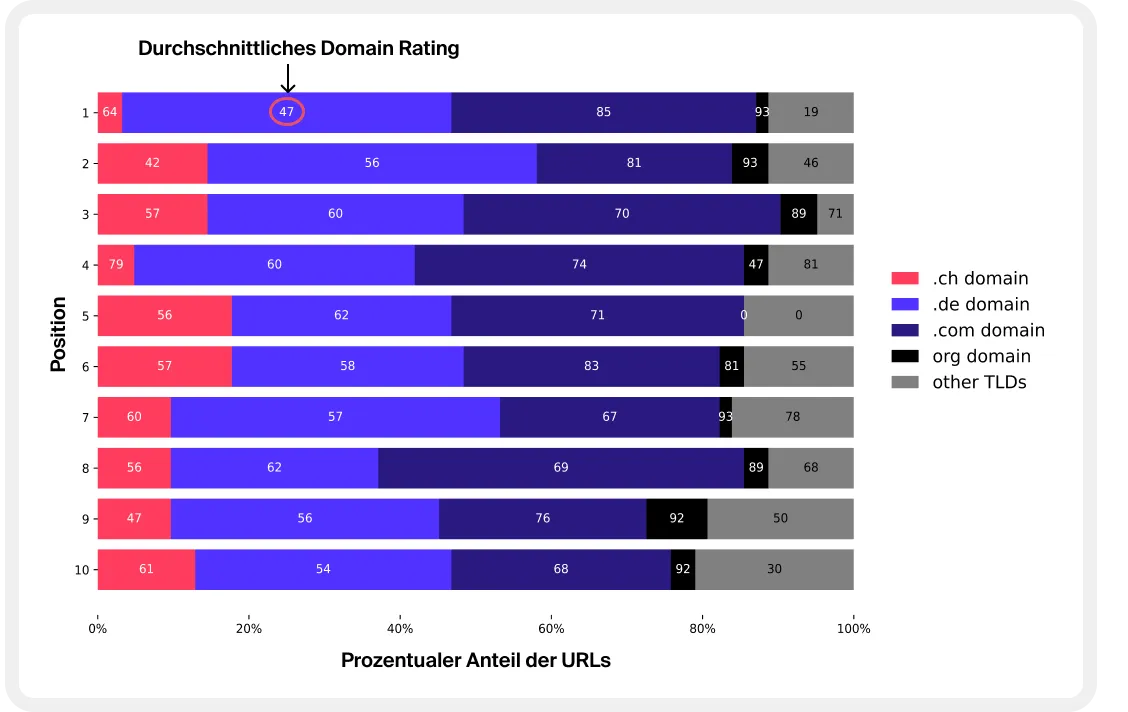
IIt is also interesting to note that .de domains often rank well for informational keywords, even if they have a comparatively low domain rating. This confirms once again that Google prioritises content quality and fulfilment of search intent over geographical relevance.
Disclaimer: The underrepresentation of .ch domains in the top 10 results could also be due to the fact that there is simply less Swiss content. This could skew the results in favour of international domains. However, we did not investigate this assumption further in our study.
{{blog-cta}}
Digression: Fragmented SERPs open up new opportunities
IDuring our analyses, we noticed that Google SERP is becoming increasingly fragmented and serves different search intentions simultaneously. This means that, for example, listicles, how-tos and landing pages can all rank for the same keyword.
This is because users' search intentions are much more diverse than they used to be. Google responds to this by offering a variety of different content to meet these different needs.
This particularly benefits those pages that cover different search intentions simultaneously and combine both informational and transactional content. Such ‘hybrid pages’ often achieve good rankings in search results.
This pattern can be clearly seen in the following example for the keyword ‘IT solutions’. The search results page shows a mixture of informational and transactional content. Bechtle.com has managed to cover both search intentions with a hybrid approach, even qualifying for the featured snippet.

Conclusion on the domain strategy
Our analysis shows that the choice of top-level domain can definitely influence SEO performance. However, there is no clear evidence that .ch domains generally perform better in Switzerland.
International .com domains dominate, especially for informational keywords such as wikis, how-tos and listicles, which means that the ‘home advantage’ of .ch domains seems to be less powerful than high-quality content and high domain ratings for those search queries.
On the other hand, .ch domains win out when it comes to transactional keywords, where Google apparently places greater weight on regional relevance. This development reflects Google's increasing focus on localised search results.
In addition, the increasing fragmentation of search results opens up opportunities for hybrid sites that combine both transactional and informational content. Such sites can serve different search intentions simultaneously and thus benefit from better rankings.
In summary, both local relevance and high-quality content are crucial for success in search engine optimisation and should go hand in hand.
5 recommendations for your domain strategy as a Swiss IT service provider
If you are a Swiss IT service provider and want to maximise your online presence and visibility, we recommend that you take the following steps:
1) SFocus on .ch domains for local markets: A .ch domain strengthens your local presence and increases your chances of achieving good rankings in Switzerland, even with a lower domain rating. Use this advantage to secure your local relevance and top rankings.
2) Optimise for transactional keywords: As a local service provider, you should primarily focus on transaction-related keywords such as ‘IT service provider Zurich’. With your .ch domain, you as a Swiss provider have a clear advantage over foreign competitors and can thus gain valuable clicks.
3) Develop hybrid landing pages for fragmented SERPs: Create pages that combine informative and transactional content to cover different search intentions. This is particularly suitable for keywords such as ‘IT solutions’, where there is both a need for information and specific service requests. Adapt your content strategy flexibly and regularly test different formats to take advantage of SERP fragmentation as an opportunity.
4) Fill gaps in search results with high-quality content: If many .de or .com domains rank for informational keywords, this is a sign that there is currently little high-quality Swiss content available. This is your opportunity: Create high-quality content yourself and dominate the rankings in Switzerland.
5) Use .com domains for international markets:
This recommendation is aimed at internationally active companies. If you operate globally, you should use generic TLDs such as .com. They offer you worldwide flexibility and are well established in various markets. Although there may be minor disadvantages for transactional keywords, the consolidated domain rating gives you additional advantages for a good ranking.