The Idea Farm: 8 sources for constantly finding new content ideas
The Idea Farm: 8 sources for constantly finding new content ideas
Can't see the content for all the options? Have you already implemented all your good ideas? And everything else you can think of doesn't fit your brand? You're not alone with these problems.
Many marketers face exactly this challenge. There's a lack of ideas for good topics, and you can't constantly devote your already limited time to content production. That's why the process is usually unplanned and ad hoc.
But that's like sowing vegetables randomly, standing next to the cultivated field and hoping that lettuce, peas and carrots will grow on their own. It may work sometimes – if there's enough rain, no snails appear and the sun shines properly – but sometimes it doesn't. However, we want more structure and certainty so that our harvest is successful.
So we need a plan – for our vegetable plantation as well as for content marketing. Let's take a look at how best to tackle this challenge. We'll show you how to regularly create good and valuable content ideas. And we'll explain how you can use them to build a functioning and long-term successful content process.
Where do content ideas come from?
There are countless accessible sources of ideas. The challenge is to recognise these sources, use them appropriately, structure the ideas they contain and prepare them for our purposes.
And that's just like working in the field: sowing, nurturing, harvesting. You have to plant ideas (by recognising and noting them down), they need the right care (like weeds, you have to weed out less valuable ideas so that the exciting topics have room to grow) and you have to pick them at the right time (cleverly connect individual ideas and shape them into goal-oriented blogs).
And which ideas should we nurture and cultivate on our farm?
A good idea, or rather the content generated from it, appeals to the right people, i.e. our target audience. It is original and creative, stimulates thought and triggers emotions.
This overview of our framework for content market fit gives you an idea of where you can generate ideas from:
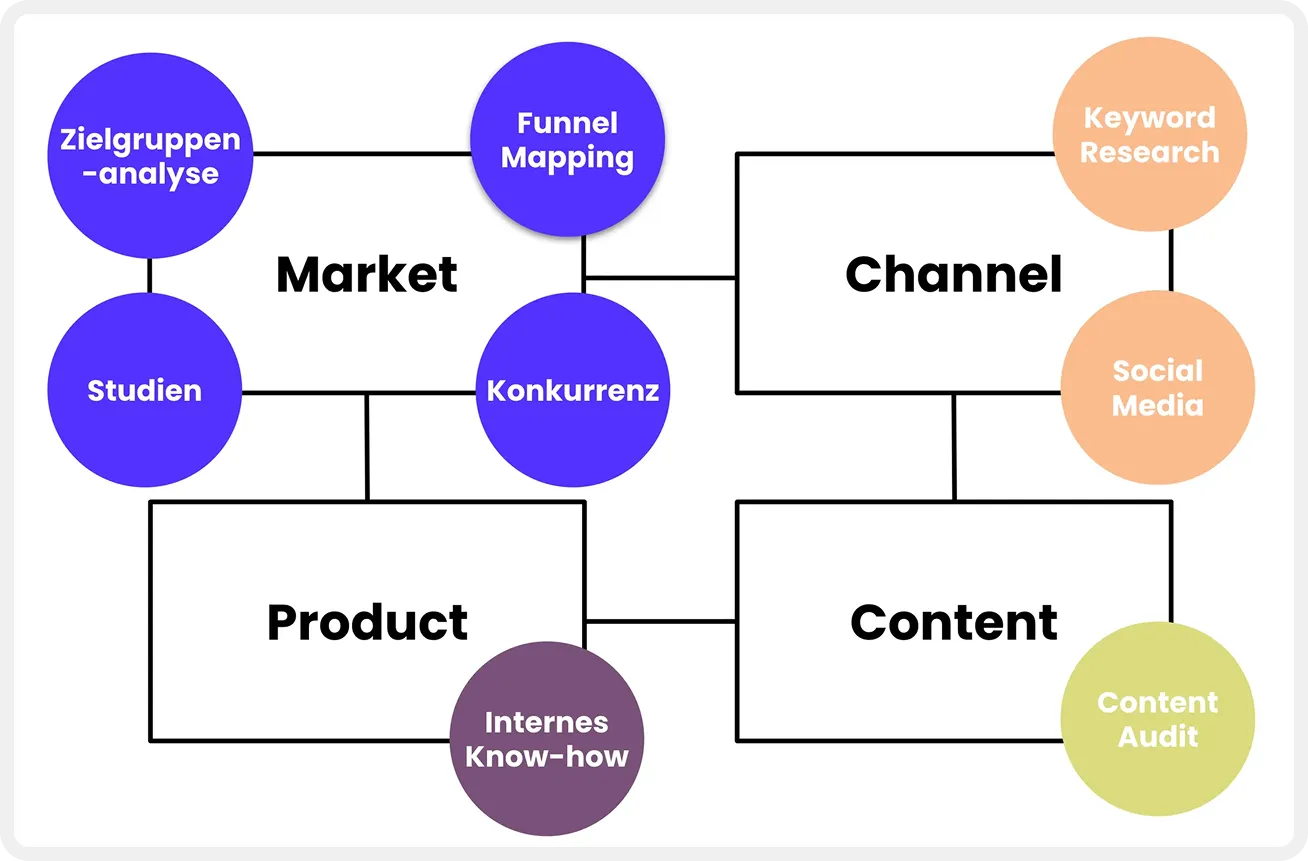
In order to continuously provide our target group with content, it is important to structure our idea farm and plan how we deal with ideas. If we do this correctly, we can efficiently and sustainably produce content that we can distribute across different channels and that ultimately has an impact. This saves us time and allows us to get the most out of our ideas.
Source 1: Draw inspiration from the needs of the target group
It helps if we learn to see our content as a product that solves a problem for our target group. In order to know what problem our content should solve, we first need to learn more about the needs and problems of our target group. This requires a thorough target group analysis.
Marketing personas are too superficial. It is better to use the Jobs to be Done framework as a guide. A central element of the framework is the ‘Four Forces of Progress’. These explain why customers choose new products, what their purchasing motives are and why they part with old products.
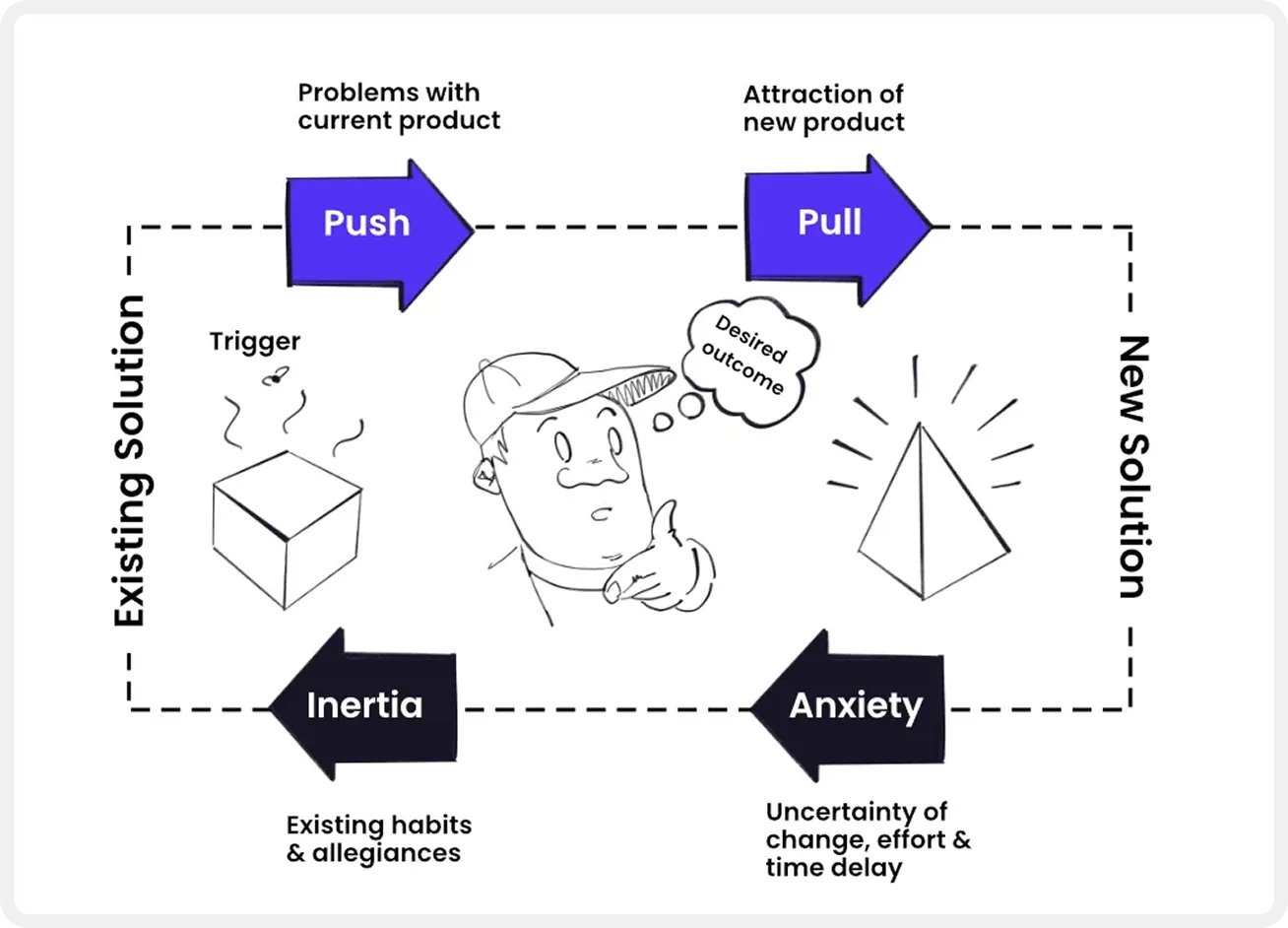
Um die Beweggründe hinter den Kaufentscheidungen der Kund:innen zu verstehen, gilt es Folgendes herauszufinden:
- Trigger: What motivates customers to look for a new solution?
- Push: What difficulties and disruptive factors do our customers face in the current situation?
- Pull: What advantages of a new solution are particularly appealing to customers?
- Inertia: What do customers like about the current solution that makes change difficult?
- Anxieties: What concerns, worries and uncertainties arise in connection with the new solution?
- Desired Outcome: What does the new solution enable customers to do and how does it change their lives?
If we ask these questions in interviews with our best customers, we can gather a wealth of highly relevant and exciting information. And we automatically find a variety of topics that we can cover as content.
Source 2: Mapping needs against the funnel
Once you have identified your customers' pains and desires, you can use funnel or customer journey frameworks to delve even deeper into their world and identify ideas along the entire journey.
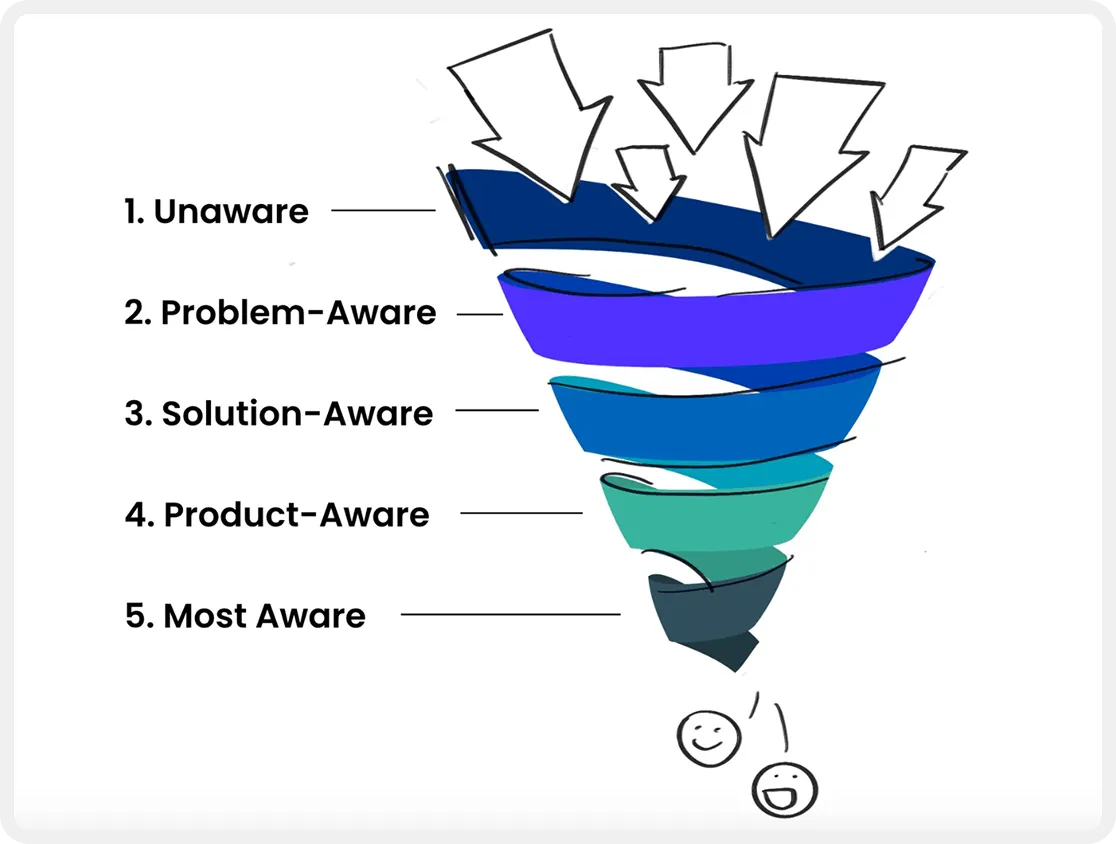
We use the ‘5 Stages of Awareness’ from the book ‘Breakthrough Advertising’. It outlines five fundamental stages that the target group goes through on their way to making a purchase. Think about which essential questions need to be answered at each stage in order to move customers further along in their journey.
[[callout]] The 5 Stages of Awareness
Unaware: The target group is not yet aware of its own problem.
Problem Aware: The target group has recognised that a problem exists.
Solution Aware: The target group is looking for the right solution.
Product Aware: The target group compares different products/offers.
Most Aware: The target group compares prices, looks for discounts and completes the purchase.
[[callout end]]
Source 3: Keep an eye on the competition
It's worth taking a look at what your competitors are doing and what topics they are covering:
- Websites und Content: What formats and topics do competitors cover? Who is the strongest? Who is also doing well internationally?
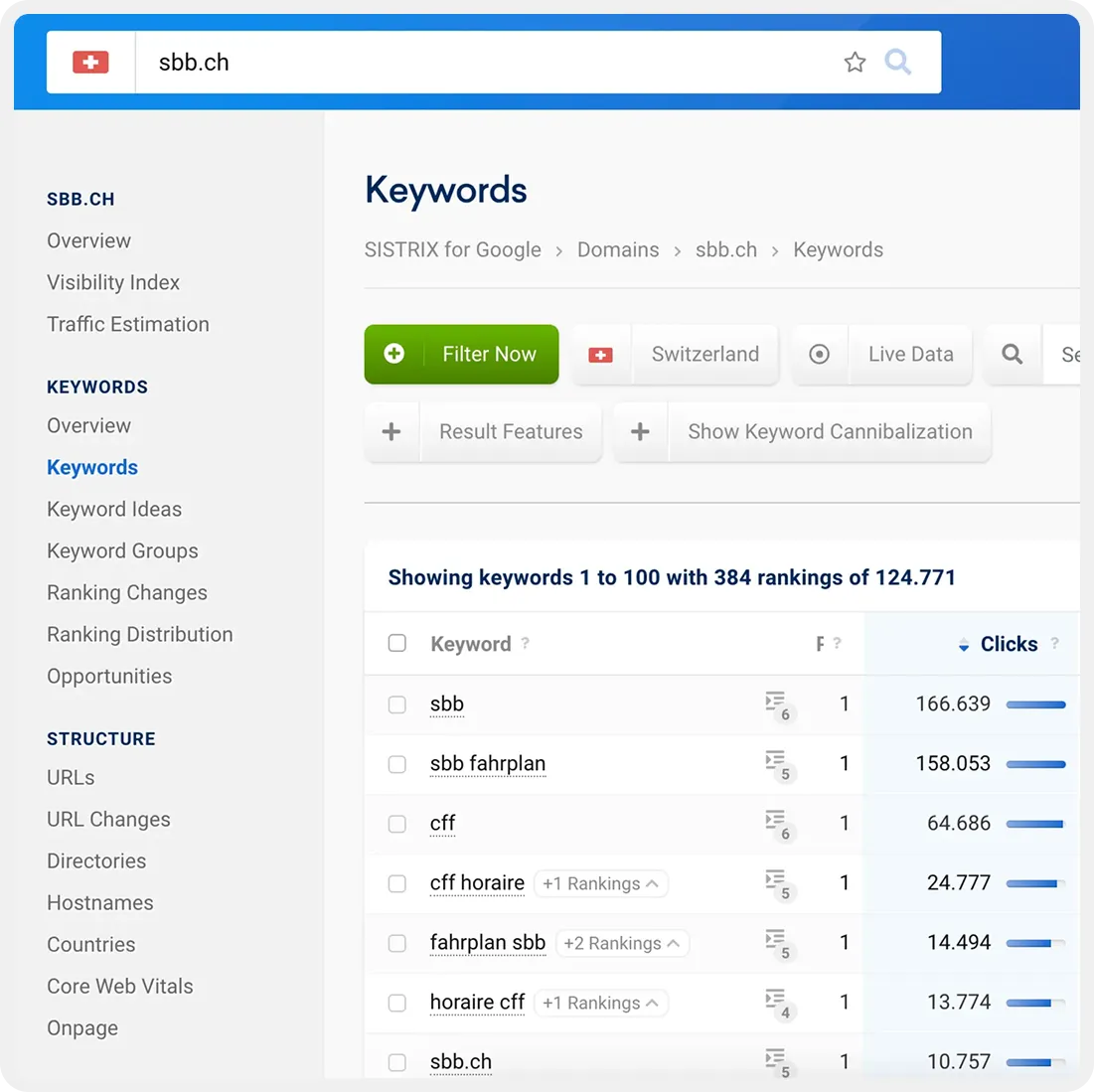
- Keyword Rankings: Who covers which topics? This can be easily analysed using regular Google tools or paid options such as Sistrix, etc.
- Social Media Presence: What works well? Which topics would also be worth covering?
- Identify gaps: Which topics are in demand among the target group but not covered by your competitors' content?
A competitor analysis allows you to check which topics work well and where your competitors are leaving gaps. Let yourself be inspired – inspiration is not the same as copying. So dare to take existing content ideas and shed new light on them with your own fresh perspective.
Source 4: Obtain current data from studies
Studies such as the McKinsey Technology Trends Outlook or the ProJuventute youth study are underestimated but equally helpful. They address important topics and trends and can save us a large part of the analysis. We can also draw on current figures and data to find out what the target group is interested in. Studies provide relevant insights, reveal potential topics and offer a good basis for our content.

Source 5: Discover potential topics through keyword research
SEO helps us develop a better understanding of the concerns and needs of our target audience. This allows us to uncover new ideas, test them and assess whether they have the potential to perform well. How does this work?
It's simple: what we google is what interests or concerns us. We google because we want to know something, buy something or do something. We use keyword research to examine the search behaviour of our target group and uncover new topics. We use SEO tools to identify frequently searched keywords and use them to form topic clusters that are relevant to the target group.
Another valuable source is the ‘People also ask’ results on Google. This is a separate section on the Google results page where similar questions from users are listed that match the search query.
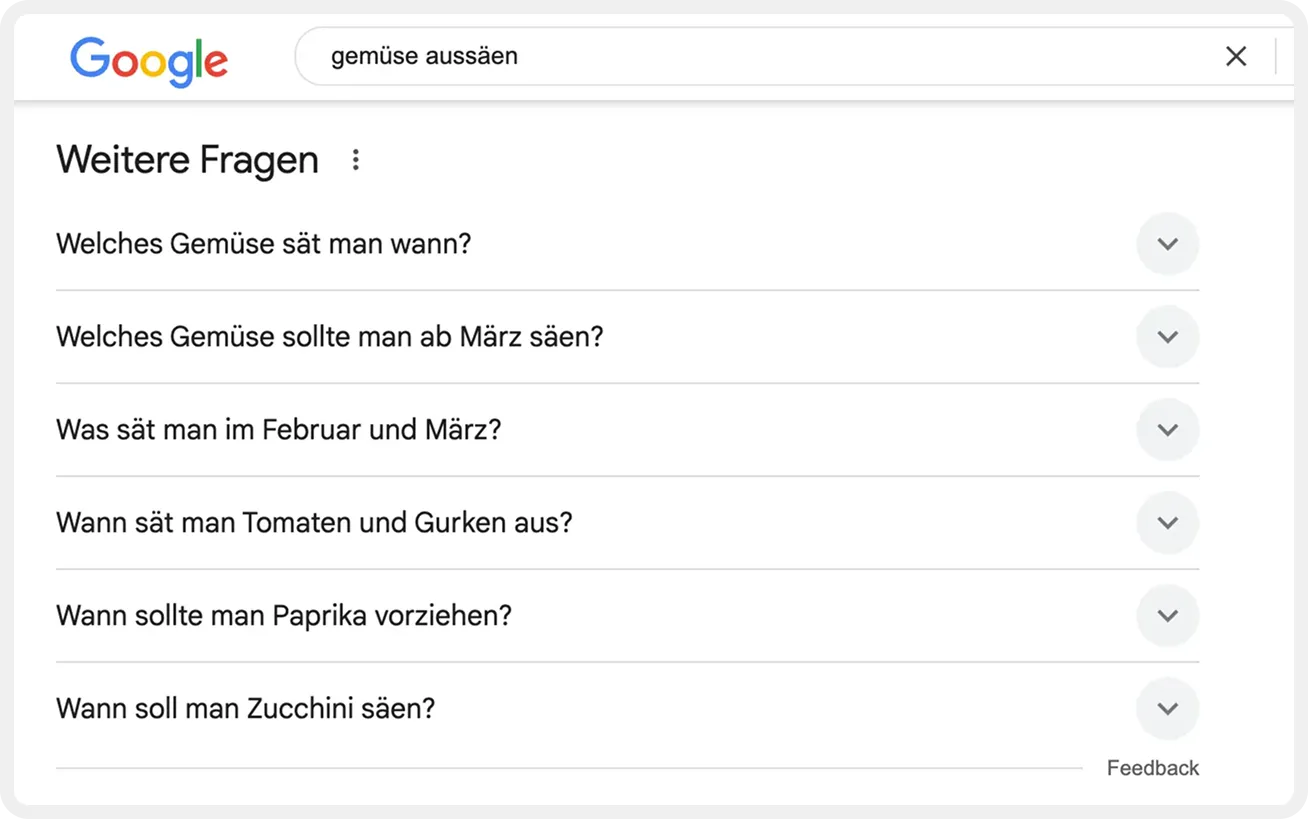
Source 6: Finding relevant trends on social media
Social media is just as relevant as Google and is the birthplace of new trends. If we analyse the various networks, for example by searching for relevant hashtags, we come across content that can serve as inspiration.

One advantage of social media over websites or blog posts is that the target audience can express their needs directly. Industry-relevant communities can be very valuable for interacting with (potential) customers and identifying their wishes and challenges.
{{blog-cta}}
Source 7: Re-evaluate your own content
Writing and reading your own content can also lead to new ideas. If a topic has worked well, we can go into more detail or highlight different aspects in a subsequent post.
For example, after the post on ‘Ideation’, we could do a post on ‘Content Marketing Funnel’. From there, we can delve even deeper into detail, for example, on ‘Bottom of Funnel Content’ and so on. Spoiler: we've already done that.
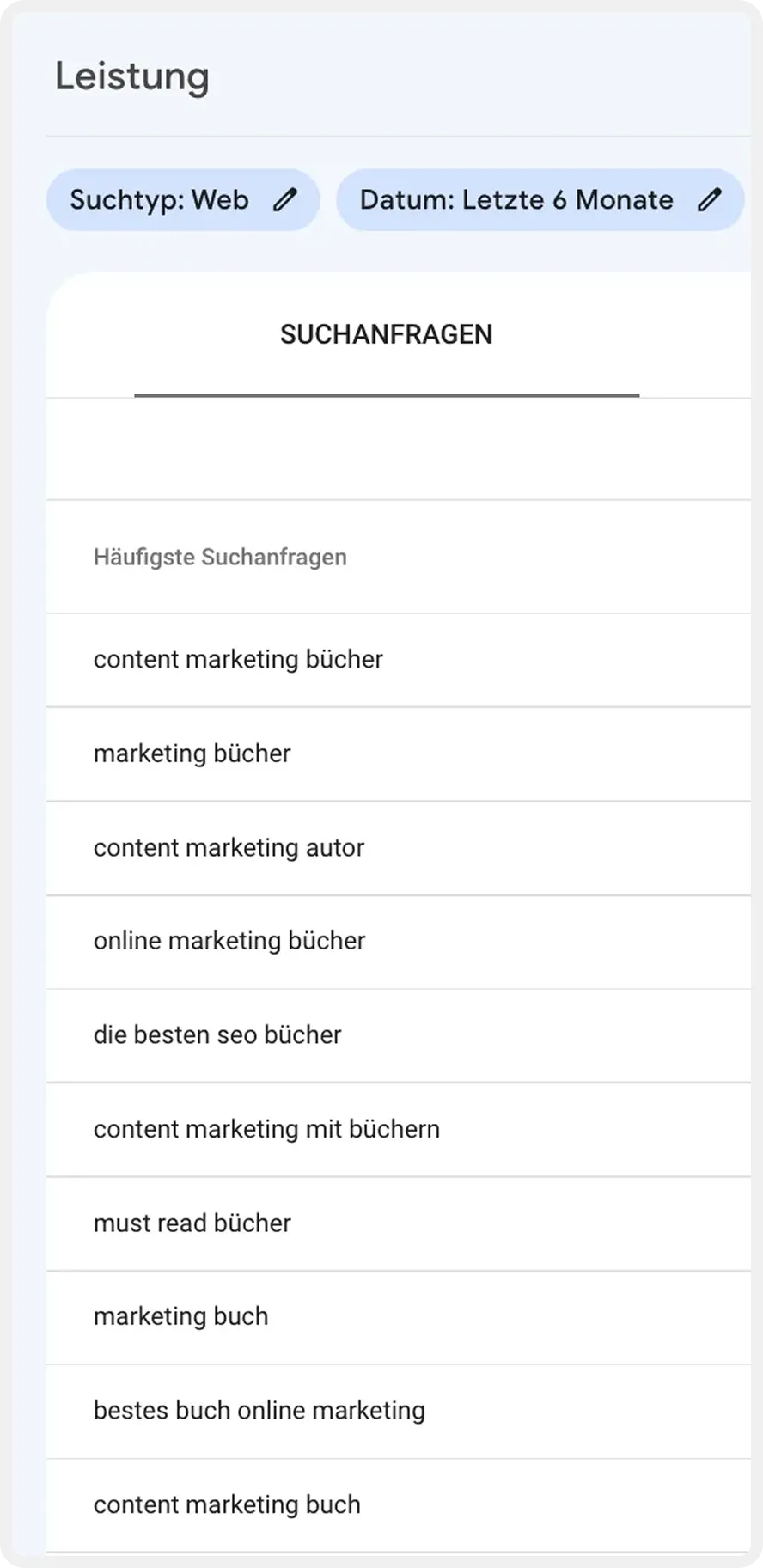
The results of an analysis in Google Search Console also help us find out which other related topics are relevant or searched for on our website. For example, when looking at the topic ‘content marketing books’, we see that people are also searching for SEO books.
Source 8: Valuable expertise of internal employees
Valuable resources and expertise exist not only outside the company, but also internally. Employees who are in daily contact with customers (e.g. sales or customer support) are particularly familiar with the needs of the target group.
Use the internal expertise on your target group to uncover potential ideas.
But all those who are intensively involved with the product or service are also a good source of information about your target group and their needs, or about the product or service itself. For example, they know the advantages of your offering over the competition.
Just as with target group analysis, it is worthwhile to use interviews to find out their respective points of view and opinions. This allows you to continuously generate new topics and ideas, which you can then check via SEO, for example.
Providing guidance with a sowing calendar
Now that we have used all these sources and continuously collected topics, the most time-consuming part of the work is already behind us. We are now faced with the challenge of organising, prioritising and further developing the content ideas. To turn the list of ideas into a productive idea farm, you can proceed as follows:
- Fit for target groups: How well do the topics suit the target group? Is the content really relevant for users? And are we solving an important problem or just trying to write something that ranks well? This allows you to filter out unsuitable topics and prioritise suitable ideas.
- Business-Fit: How well do the topics fit with the company's positioning? This question is crucial for credibility: if, for example, an insurance company focuses on content related to recruitment, Google and the target group will quickly notice that it has no expertise in this area. Think about how easy it is to mention your product or service and evaluate your content ideas accordingly.
- Timing-Fit: Is now the right time to tell this story? And how long do we think this topic will remain relevant? Is it worth investing in? Sure, there is evergreen content, but these are rare gems and not every topic lasts forever.
From idea to process
With all the measures described above, however, we should always remember that it is important to find the right channel, format and perspective for each idea, as well as value-adding media such as visuals.
Here, we like to take a leaf out of Netflix's book – one of the world's largest content producers.
Their innovation cycle process follows four steps:
1. Find differing opinions and ‘socialise’ your idea.
No idea is perfect from the outset. To refine it further and help it succeed, Netflix recommends discussing all interesting ideas with the team. While it makes sense for one person to take the lead on an idea, it is often the feedback from colleagues with different perspectives from different areas that helps an idea move forward.
A good basis for a team discussion is a detailed briefing that describes the idea in detail and clearly defines why this content idea must be pursued. This way, you avoid pursuing ideas that you think are great but that no one else is really interested in.
2. Test an idea if it requires a lot of resources.
Certain ideas that are very complex to create should be tested first. If you have the idea of writing an e-book, it will probably take several months to create. Instead of jumping straight into the writing process, it makes more sense to test your own hypotheses on a smaller scale.
[[callout]] Example:
Aaron Orendorff wrote a Twitter (X) thread on the topic of content writing based on a conversation with a colleague (interview). The feedback on Twitter was so overwhelming that he decided to write down his process, supplement it with videos, and use it as a lead magnet.
[[callout end]]
3. Decide whether you want to pursue the idea.
If you have a concrete idea or perhaps even positive results from your prototype testing, Netflix says you become the project manager (they call it an ‘informed captain’), meaning you are responsible for researching, making decisions and executing the project. The feedback from step 1 and the tests in step 2 should empower you as the project manager to take the next steps.
4. If the idea is successful, celebrate it. If it fails, share what you've learned.
If your idea is successful, let the team know. At Digital Leverage, we even have a dedicated Slack channel for this.
Did you work hard on your idea, gather feedback on the initial briefing, test it and take the lead – and it still failed? Then, according to Netflix, there's only one thing left to do: learn from the experience.
Share your failures with your team just as you share your successes, so that others can benefit from them too. This sends the message that failure is part of the creative process and encourages others to pursue their own ideas, while everyone learns from the failure.
All these steps help us to create the right content for the right target group at the right time in the customer journey.
In addition, you can use topics and content (as mentioned above) more than once. With extensions, additions, summaries or different formats, you can get the most out of them. So when gathering your ideas, think beyond a single channel.
One idea can lead to five more, and so with ideation in the content process, you create an idea farm that promises you a bountiful harvest.