
LLMO/GEO Benchmark Study 2025: How are Swiss companies optimising for AI search?
LLMO/GEO Benchmark Study 2025: How are Swiss companies optimising for AI search?
Suddenly, everyone is talking about AI search. Terms such as LLMO (Large Language Model Optimisation), GEO (Generative Engine Optimisation) and AEO (Answer Engine Optimisation) dominate marketing news.
The pressure to keep up is growing, but many are uncertain: how far along is this topic really? And how are others dealing with it? At the same time, there is little reliable data from the DACH region – and certainly not from Switzerland.
That's exactly why we wanted to know where Swiss marketing teams stand today.
Between July and September 2025, I sent hundreds of emails and LinkedIn messages asking for an assessment.
237 marketing managers from Switzerland with a clear priority on organic search responded*.
Here are the key findings:
[[callout]]
TL;DR
1. Impact of AI search in Switzerland: 32% of Swiss companies are already losing clicks due to AI responses. However, the decline is more moderate in Switzerland than in other markets.
2. LLMO/GEO strategy level: Only 8% of companies will have a clear LLMO strategy in 2025. Most are in a transitional phase: Initial measures are being implemented, but without clear processes.
3. Measures implemented: Despite the lack of strategy, many marketing teams are already optimising content and technology and are starting to monitor. However, external signals such as digital PR are still rarely used and remain an untapped lever.
4. Obstacles: The biggest barriers are a lack of resources, unclear prioritisation and a lack of LLMO knowledge. It is not so much a lack of will as a lack of time, structure and know-how.
5. Monitoring & Tools: More than half of Swiss companies do not measure their AI visibility. Without tracking, there is no basis for meaningful optimisation. Companies that are ahead of the curve use established tools such as SISTRIX or Ahrefs, as well as early specialised tools such as Peec AI.
6. Budget & Outlook 2026: 21% of Swiss companies are planning a higher LLMO/GEO budget for 2026. Those with a clear strategy are more likely to expand. Uncertainty remains high – the coming year will be the first real opportunity for many to assess their position.
[[callout end]]
*We deliberately only included companies for which organic search has a medium to high priority in the evaluation (237 companies in a total of 273 responses). A benchmark is only valuable if the comparison group has similar goals, genuine pressure to act and a real dependence on the result. Companies for which organic performance is secondary do not provide reliable evidence of how LLMO is practised in real marketing teams.
1. Starting point: What impact does AI search have on Swiss websites?
Survey Results
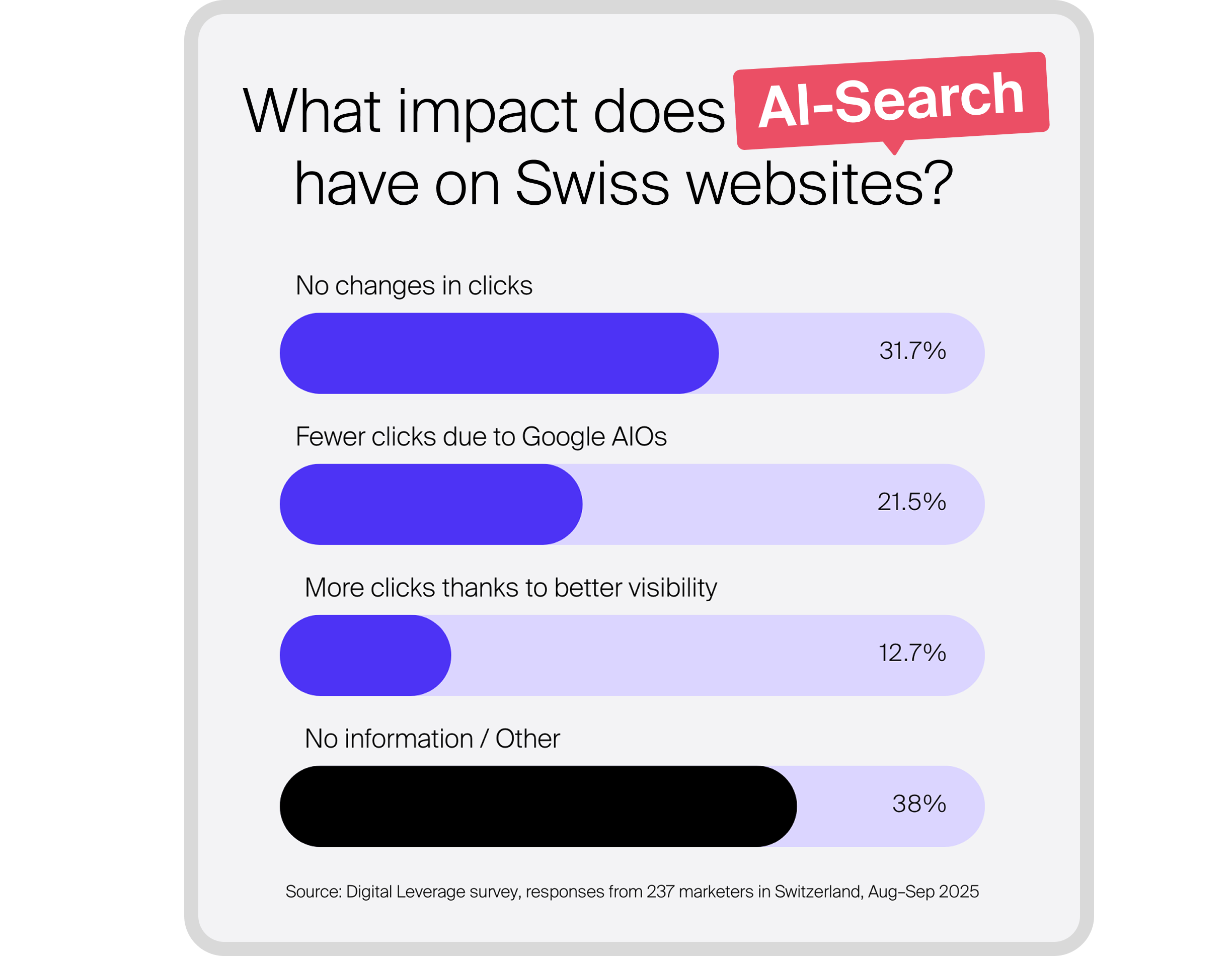
More and more users are receiving answers directly in the search results or via AI chatbots. Organic clicks on external websites are becoming less common. However, according to our survey, the decline in Switzerland is still relatively moderate:
- 31.7% of respondents have not yet noticed any clear changes in click numbers.
- 21.5% of respondents report a decline in clicks due to AI-generated search results.
- 12.7% of respondents report an increase in clicks.
Conclusion
Overall, there are significantly more losers than winners. This comes as no surprise: studies from the US show an average decline in clicks of around 34 per cent as soon as AI responses are visible.
Fortunately, Swiss companies are not yet as widely affected by Google's AI overviews (AIOs) as we first thought – presumably because of the later rollout of AI functions. However, the time buffer is small.
AIOs are becoming increasingly common, and AI mode has also been available in Switzerland since October 2025. Studies show that users appreciate AI functions for quickly gaining an overview of a topic. A return to classic search results is becoming more and more unlikely.
Companies are also getting more clicks from ChatGPT and Perplexity. Investments in content or technical improvements can even increase Google clicks in the short term. However, the traffic gains are not enough in the long term to offset the losses caused by Google's AI features.
2. Strategy: How many Swiss companies have an LLMO strategy?
Survey Results
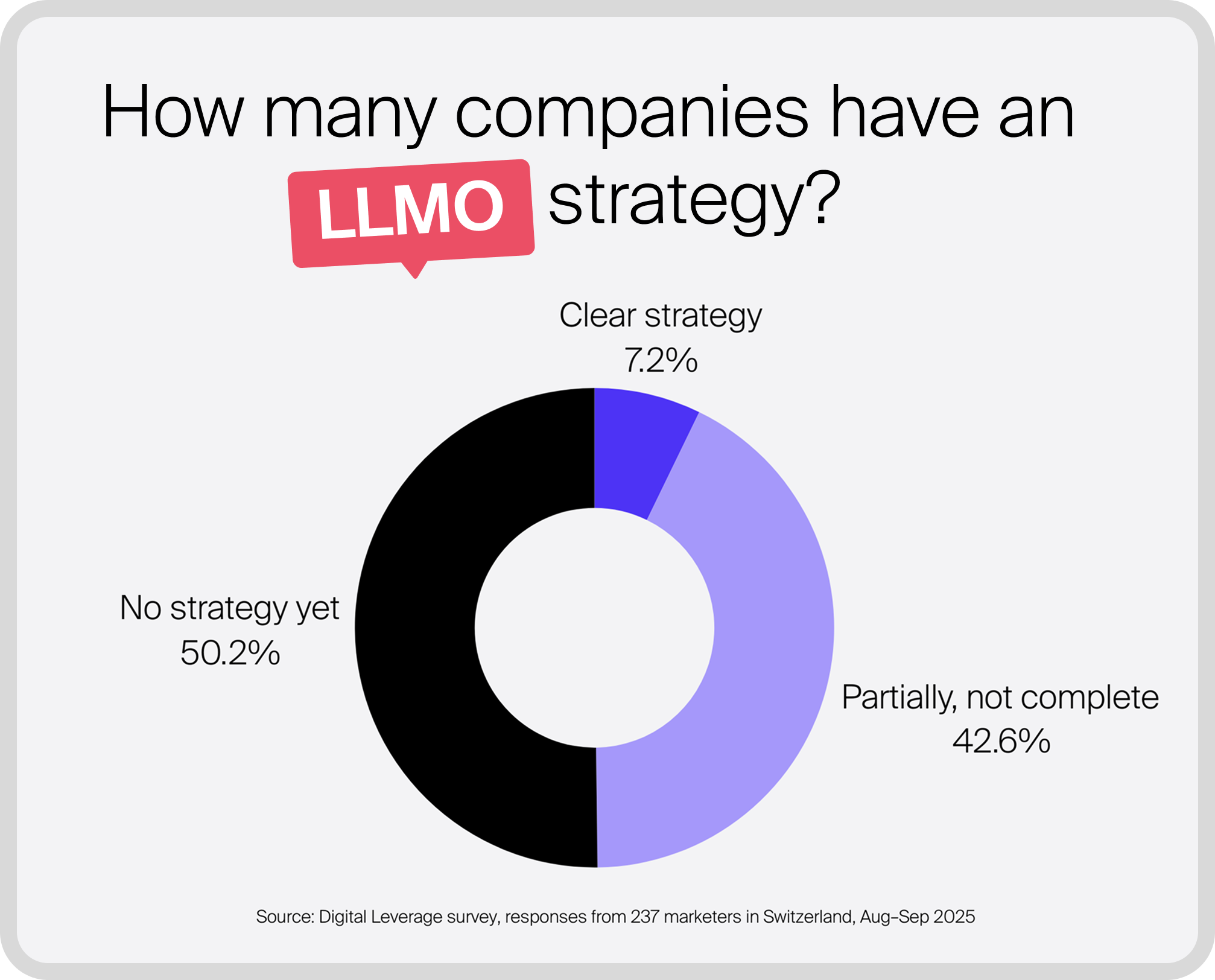
Only a few companies have a clear LLMO strategy in 2025. And that's despite the fact that we are only evaluating responses from people for whom organic search is a medium to high priority.
Overall, the results show that:
- 7.2% of respondents have implemented a clear LLMO/GEO strategy.
- 42.6% of respondents have a partial strategy, but have not fully implemented it.
- More than half of respondents (50.2%) do not have an LLMO/GEO strategy.
Conclusion
The fact that only a few Swiss companies already have an LLMO or GEO strategy is not a sign of passivity, but rather the result of a transitional phase. Many things are being tried out, but hardly anyone is following a concrete roadmap. There are understandable reasons for this:
Search strategies for 2025 were mostly planned in the traditional way. At the beginning of the year, neither AI overviews nor AI mode were available in Switzerland. ChatGPT still played a minor role in the everyday lives of most target groups, at least in terms of search behavior and referral traffic. The focus remained on Google. Many marketing teams waited to see how things would develop and did not see LLMO/GEO as an urgent priority. In addition, LLMO requires a shift in thinking. Away from rankings and clicks, toward mentions and citations.
Without concrete processes or frameworks, however, it is difficult to define a strategy that promises success. That is why we are currently seeing many individual measures, experiments, and pilot projects, but still few consistent strategies.
This will change in 2026. The relevant functions are live, search behavior is shifting, and the loss of clicks due to AI overviews clearly shows how much pressure organic channels are under.
3. Implementation: Which LLMO measures are currently being implemented?
Survey Results
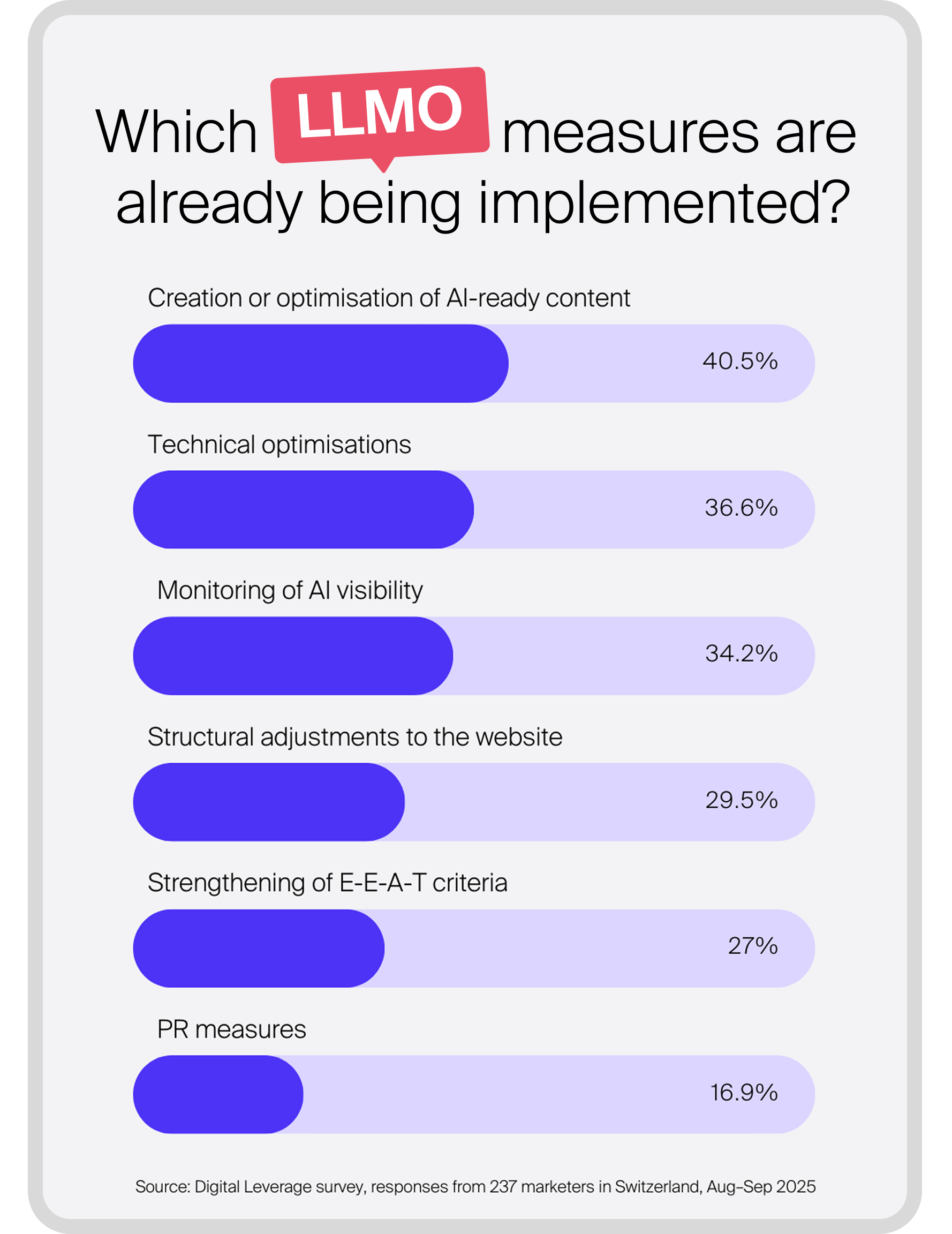
Although only a few companies have defined an LLMO strategy, more than two-thirds of respondents are already implementing measures to optimise their websites for LLMs. The most common optimisations are:
- Creation or optimisation of AI-ready content: 40.5% of respondents are already optimising content for LLMs.
- Technical optimisations: 36.3% are working on the technical optimisation of their website.
- Monitoring AI visibility (e.g. through AIO tracking or prompt tracking): 34.2% of respondents rely on AI monitoring.
- Structural adjustments to the website (e.g. new page templates, revision of the information architecture): 29.5% have made structural optimisations.
- Strengthening E-E-A-T criteria: 27% are investing in strengthening E-E-A-T signals, e.g. by creating content or author profiles.
- PR measures to optimise brand mentions: Only 16.9% of respondents are investing in digital PR to increase their network-based visibility.
Conclusion
The results show that even though most companies do not yet have a formal LLMO or GEO strategy, they are already experimenting. Many are starting with obvious topics such as content optimisation, technical adjustments or simple prompt monitoring. This helps to identify initial patterns and develop a feel for optimisation potential.
At the same time, it is noticeable that digital PR measures outside of the company's own website are still rarely pursued. However, this is precisely where there is great leverage for LLMO. Authority is not only created on-page, but equally through external signals. There is a clear need for Swiss companies to catch up in this area.
4. Obstacles: What are the biggest challenges in relation to LLMO?
Survey Results
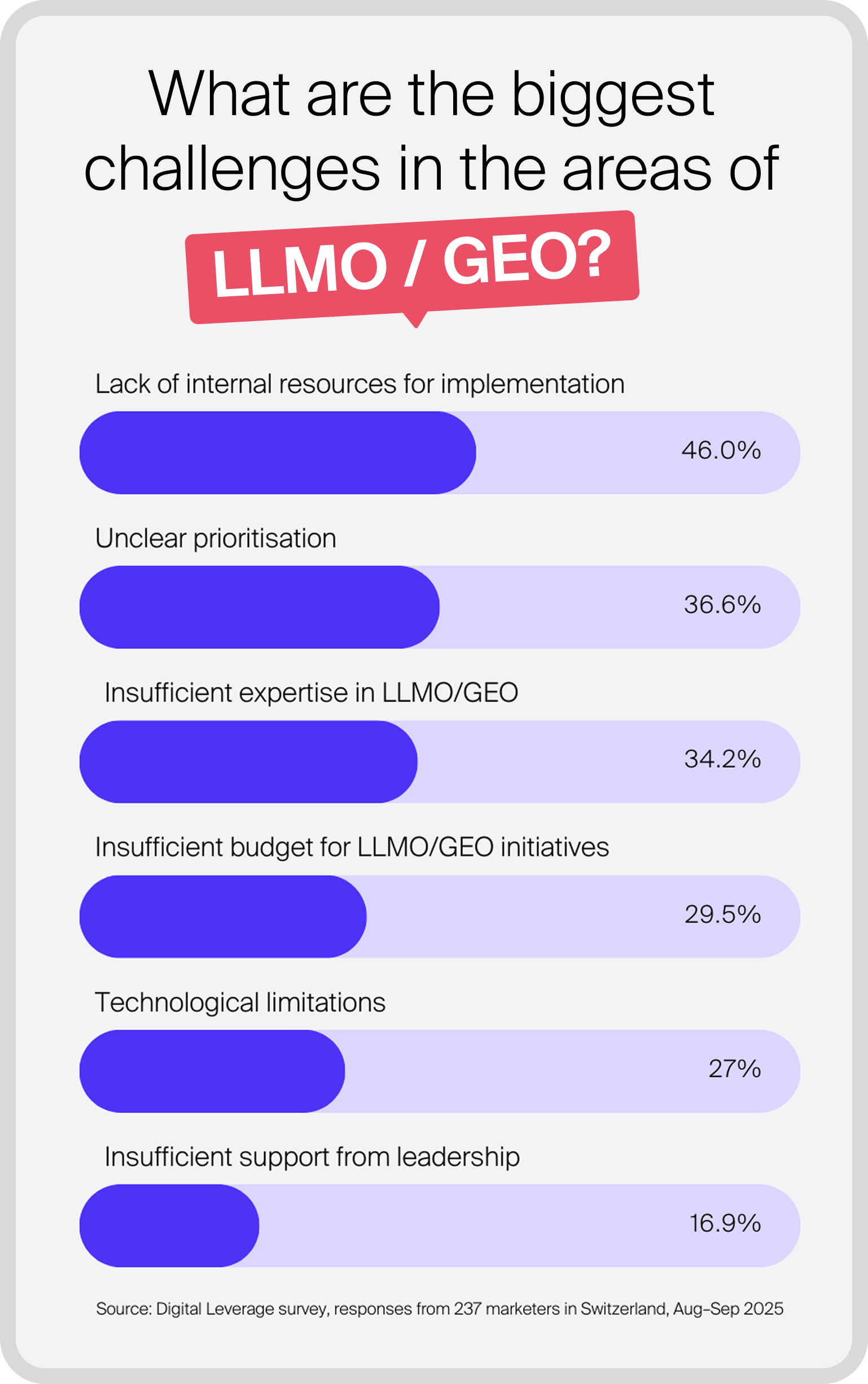
Many companies are already implementing initial measures, but are quickly reaching their limits. This is reflected in the challenges most frequently cited by marketers:
- Lack of internal resources for implementation: 46% of companies lack the internal resources to implement LLMO or GEO in parallel with traditional search or content initiatives.
- Unclear prioritisation and concrete measures: 42.6% of companies struggle with unclear prioritisation and concrete actions. When the strategy is missing, there is no clear definition or prioritisation of measures, so AI optimisation projects stall or never start.
- Insufficient LLMO expertise: 34.6% of companies report insufficient expertise in LLMO or GEO. Without a solid understanding of AI optimisation, marketing teams find it difficult to develop and implement effective strategies.
- Lack of budget for LLMO initiatives: 26.6% of companies have no dedicated budget for LLMO initiatives. Without funding for tools, content, or training, AI projects cannot begin.
- Technological limitations: 16% of companies face technological limitations such as outdated CMS systems or missing tools, which make it difficult to prepare content effectively for AI systems.
- Insufficient support from leadership or management: 8.4% of companies receive limited support from leadership. Without backing from above, LLMO initiatives lack internal priority and make little progress.
Conclusion
The obstacles mentioned reveal a clear pattern: it is not so much a lack of will as a lack of knowledge and structures.
At the beginning of 2025, there were no AI overviews nor AI Mode in Switzerland. Accordingly, no dedicated resources were planned. This explains why a lack of resources and limited budgets are the biggest hurdles today. Both are a direct consequence of the lack of strategic focus.
Uncertainty about prioritization and measures arises for the same reason. LLMO is currently being operated in parallel with classic SEO and content processes. Teams are experimenting, using existing workflows, and improvising with what is available. Understandably, there is still little expertise available. The technology is developing rapidly and requires a rethink. Many teams are working their way in step by step instead of relying on proven processes.
On the positive side, technological limitations rarely pose a real problem. Management support is also surprisingly high. This creates tailwind for teams that can use this momentum to structure or expand LLMO for 2026.
5. Monitoring: What tools are used to optimise LLMs?
Survey Results
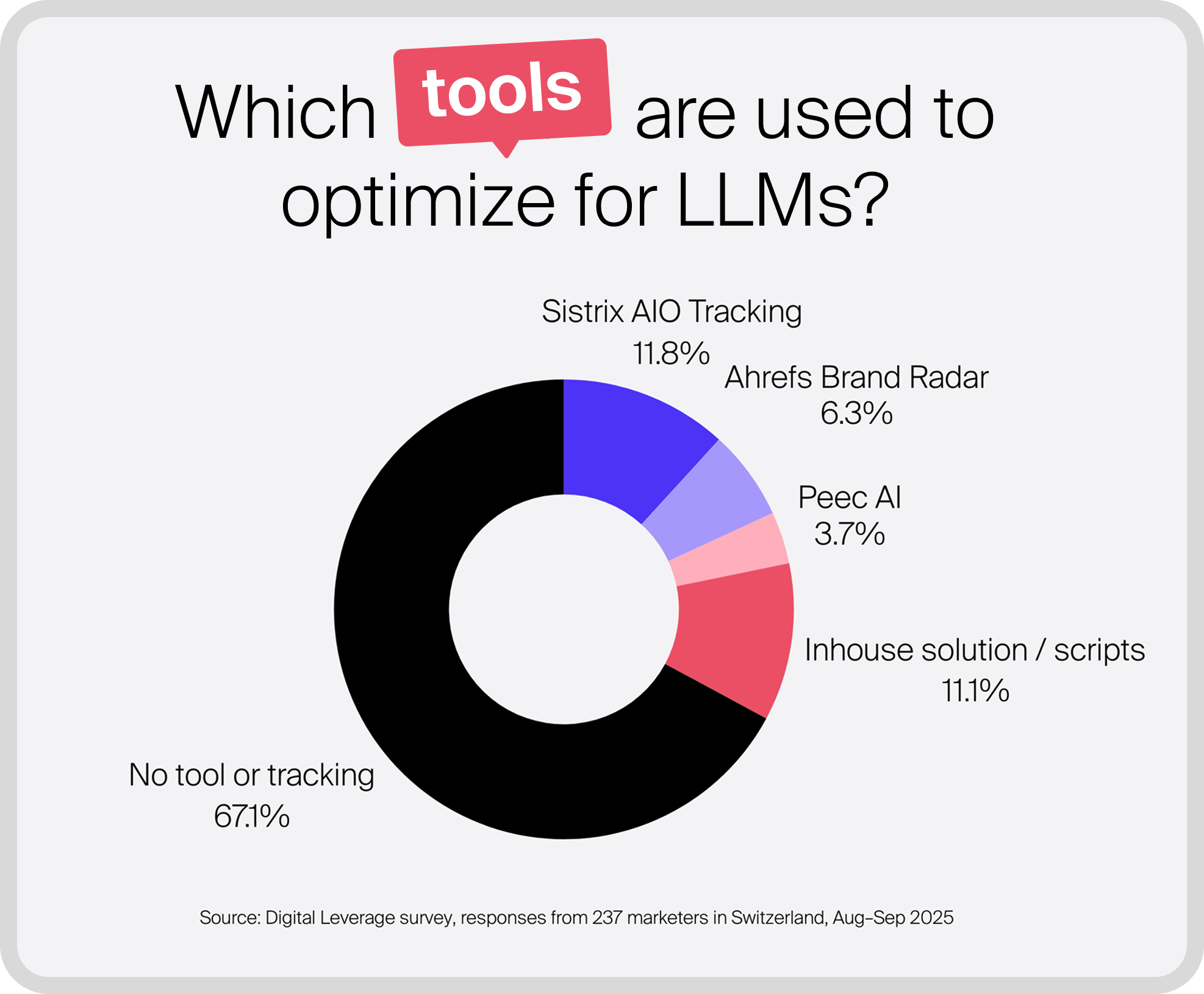
We wanted to know which new AI monitoring tools Swiss marketers are using, as this product category is developing rapidly. Here are the most popular tools for tracking AI visibility:
- SISTRIX AIO-Tracking (11.9%) The most widely used tool. Provides initial insights into AI overviews and the visibility of individual domains.
- Ahrefs Brand Radar (6.4%) Mainly used by teams that already work with Ahrefs. Focus is on brand presence in AIOs
- Peec AI (3.7%) Used as a supplement for specific use cases, especially for experimental analyses.
- Own solution or scripts (11.2%) Many teams build their own dashboards or queries, mostly via APIs or scraping solutions.
Other Tools Used:
Semrush, Otterly.AI, SE Ranking, Conductor, Rankscale
Conclusion
Although many teams are already active in the LLMO/GEO area, more than half of those surveyed do not use a dedicated tool to optimise for AI search. This is problematic.
After all, if you don't measure your own visibility, you don't know where you stand and can't respond in a targeted manner. This was already true for classic SEO and is even more so in the AI search environment, where we have less and less data at our disposal. That's why it's crucial to consistently collect available signals in order to understand what works and where there is room for optimisation.
There are currently two sensible approaches for marketers:
- Use established SEO tools: Ahrefs, SISTRIX and Semrush offer initial insights into AI visibility and combine these with traditional rankings.
- Utilise new AI tracking tools: Solutions such as Peec AI or Otterly.AI specialise in AIO presence, prompt tracking, and model analysis.
At Digital Leverage, we combine both approaches: SISTRIX for classic Google visibility and AI overviews, Peec AI for prompt tracking and model analyses.
6. Resource planning: How are Swiss companies planning their resources for LLMO/GEO for 2026?
Survey Results
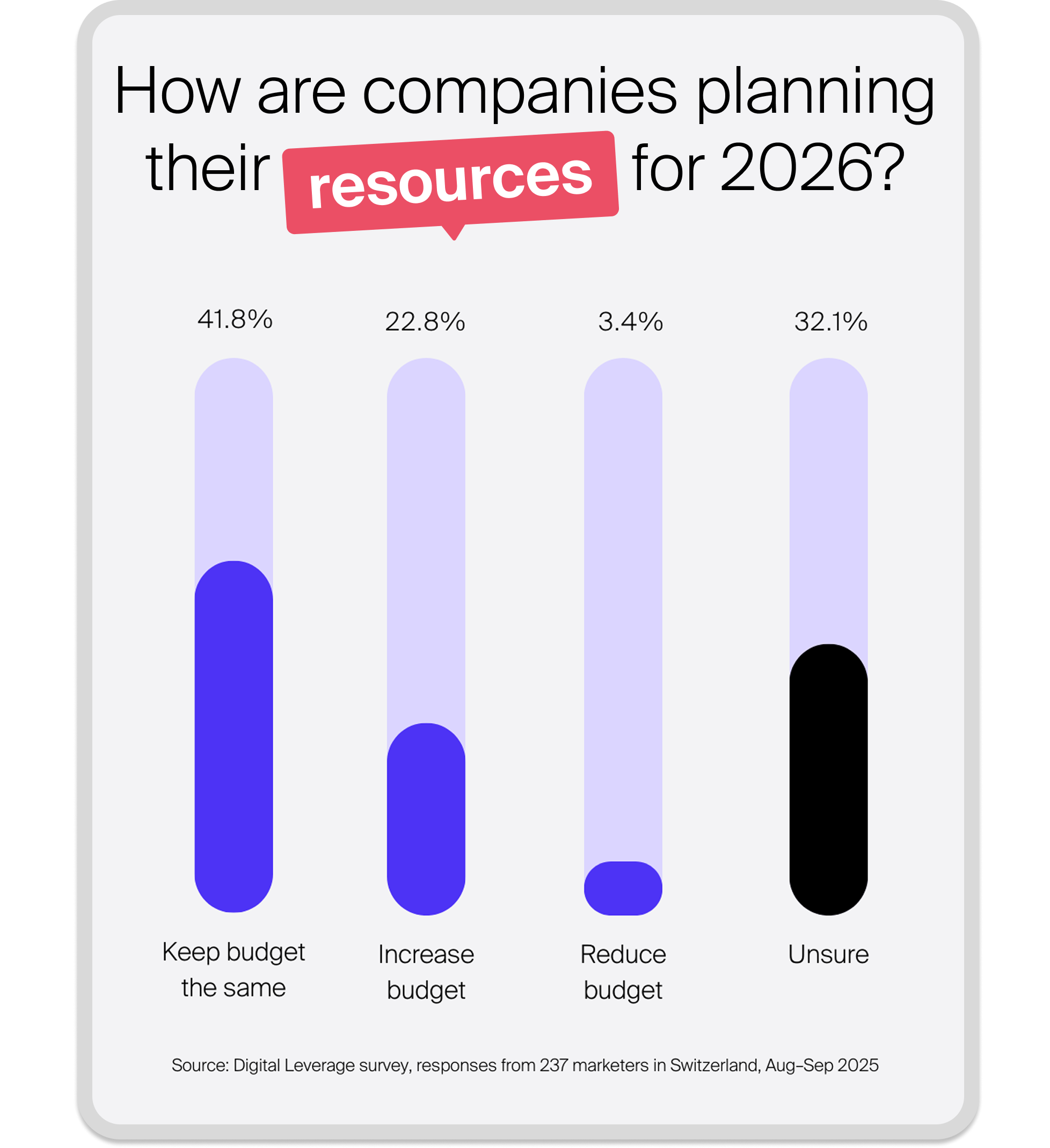
For 2026, we are seeing a stronger focus on AI-based search. At the same time, we are aware that our perception as an LLMO/GEO agency at Digital Leverage may be biased. That is why we wanted to check whether our gut feeling is correct and how Swiss companies are actually planning their resources for LLMO and GEO. The results:
- 21% are increasing their budget
- 43% are keeping their budget stable
- Very few are reducing their budget
- Around a third were still unsure about their budget planning for 2026
Conclusion
The results show that many Swiss companies are still uncertain about LLMO/GEO. It also became clear that those with a concrete strategy are planning with higher budgets. Where there is no strategy or it is unclear, expansion is usually not happening.
It is also interesting to note that only a minority will reduce their resources. This in turn suggests that the topic is present and relevant for many companies. Most have recognized that action is needed.
This makes 2026 a good time to take stock. Companies should examine where they are visible in the AI search, where they want to go, and how they can use their resources wisely to get there.
Final thoughts / Next steps
The influence of AI is changing organic search and presenting us with certain challenges, but it is also opening up new opportunities. This is because AI models redistribute topics and change competitive relationships. Those who invest in the right content, technical structures, and network-based visibility will reap the benefits.
This gives many teams a realistic chance to position themselves in areas where they have not previously achieved the desired results. Provided they make the leap from selective optimization and experimentation to concrete roadmaps and strategies.
Want to know more about this topic?
Here you will find an introduction to the topic of LLMO/GEO.
Here we showcase you how we approach LLMO/GEO strategies at Digital Leverage.
