Exact Match domains put to the test: Do they really still provide measurable ranking benefits?
Exact Match domains put to the test: Do they really still provide measurable ranking benefits?
Exact match domains (EMDs) have long been considered an easy way to achieve good Google rankings with minimal effort. But what is the situation today? Have they had their day, or do they still offer a ranking advantage?
To answer this question, we analysed 500 search results. We examined whether EMDs continue to offer a ranking advantage, what role domain rating plays, and whether there are differences between generic and locally-related keywords. We also show you when it is still worth using an EMD today and when it is better to steer clear of them.
[[callout]] TL;DR
- EMDs rank above average in Google's Top 10: Our analysis shows that exact match domains continue to be strongly represented in the top search results.
- EMDs require a lower domain rating: On average, EMDs need a 60% lower domain rating than other domains to appear in the top 10.
- The majority of EMDs only rank for their main keyword: EMDs achieve little visibility for other relevant terms – 70 percent of the domains analysed rank exclusively for their main keyword.
- Content quality remains crucial: EMD alone is not enough – high-quality content is still the key to long-term success.
[[callout end]]
Background and objective of the study
EFor a long time, exact match domains were considered an easy way to rank well on Google. These are domains that correspond exactly to a relevant keyword, for example, ‘driving-school-london.co.uk’. This strategy was particularly widespread among SEOs before 2012: with a suitable domain and minimal effort for content creation, top rankings could be achieved quickly and easily. But that changed in September 2012, when Google's EMD update specifically penalised sites that ranked well solely because of their domain name but offered little added value.
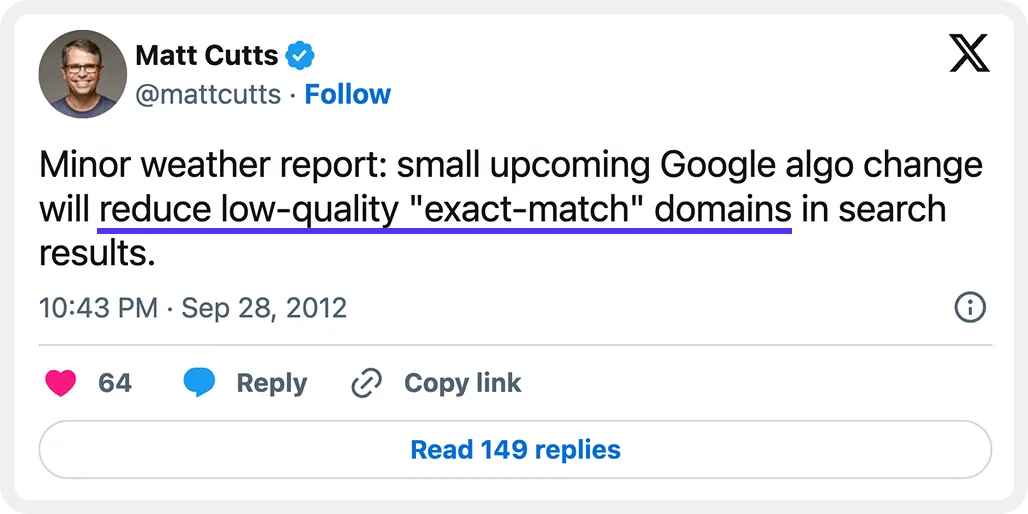
Despite this measure, the topic of EMDs continues to be a hot topic of discussion in the SEO community. Many SEO experts believe that EMDs still have a ranking advantage.
We at Digital Leverage have also repeatedly found that EMDs rank surprisingly well for competitive keywords despite their low domain rating. But we wanted to know for sure, so we conducted this study.
Proceed
Data Collection
For our study, we selected 51 keywords that generate at least 10 search queries per month in Switzerland. The focus was on keywords that are particularly suitable for EMDs, such as job titles and service descriptions. We divided these into two groups:
- 26 keywords with location information (e.g., “driving school Zurich”)
- 25 keywords without location information (e.g., “moving service”)
Only keywords for which at least one exact match domain ranked in the Google Top 10 were taken into account in order to enable a direct comparison between EMDs and other domains. After data cleansing, 509 results remained, 259 of which were location-related and 250 of which were not.
Data Analysis
After collecting the data, we analyzed it using descriptive statistical methods to identify meaningful patterns and trends. Our goal was to analyze the performance of exact match domains compared to other domains and to check whether there are actually measurable differences in ranking.
Reasoning behind the methodology: Given the numerous elusive factors that influence search engine optimization, we deliberately avoided complex statistical calculations in our analysis. Instead, we focused on applying descriptive statistics to identify relevant patterns and trends without establishing causal relationships. The results of the study therefore merely reflect general trends and do not claim to be statistically significant.
Limitations
Like any study, ours has some limitations that should be taken into account when interpreting the results.
- Market relevance: The analysis refers exclusively to Google and the Swiss market. The results cannot be readily transferred to other countries or search engines.
- Limited keyword set: Only keywords for which at least one EMD ranked in the top 10 were taken into account. Other search queries were not analyzed, which limits the generalizability and could distort the results.
- Data currency: The data is from the end of 2024 and therefore represents a snapshot in time. Changes in Google algorithms could influence the results in the future and limit the reproducibility of the study.
- No content analysis: The quality of the content on the domains was not examined in detail, which is why no general statements can be made about the content strength of the websites.
These limitations show that the results primarily serve to identify trends and patterns and do not allow for absolute statements about the long-term performance of EMDs.
{{blog-cta}}
Results
EMDs tend to rank better
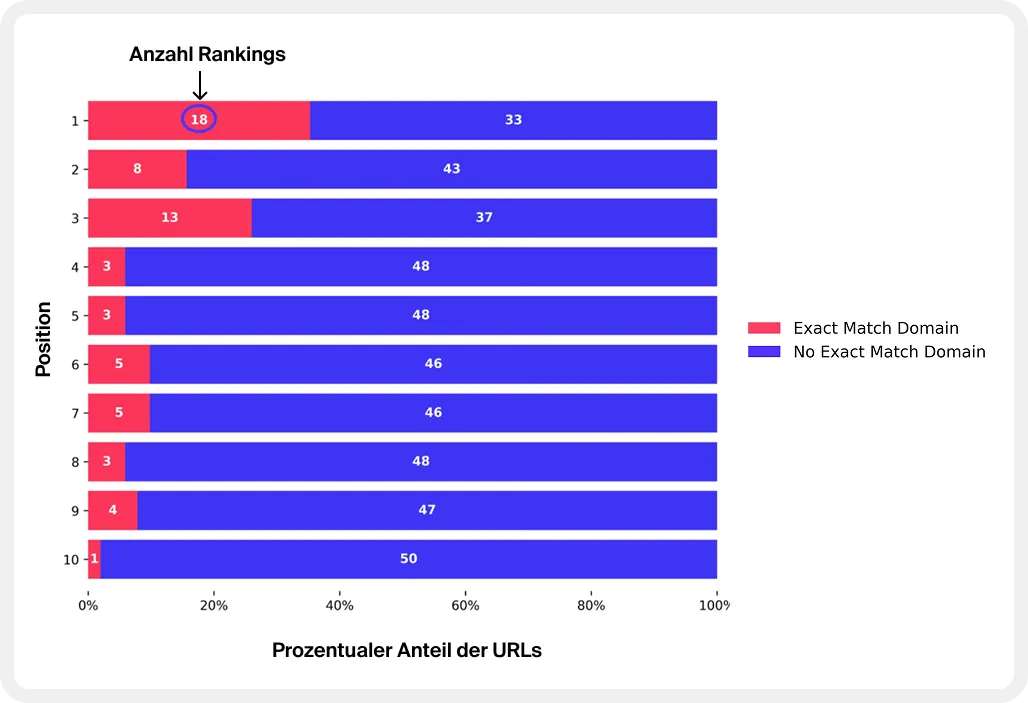
Our analysis shows that exact match domains are represented in the top 10 with above-average frequency. Their strong presence in positions 1 to 3 is particularly striking—both for keywords with location information and for search queries without local reference.
The chart below clearly shows this effect: around 25% of the domains in the top three positions are exact match domains. This means that they are significantly more common there than in positions 4 to 10, where their share is less than 10%. This distribution suggests that the match between keyword and domain name could continue to be a ranking signal for Google.
EMDs also rank well with a low domain rating
Another interesting finding is that EMDs require a significantly lower domain rating to rank in the top 10 search results than other domains.
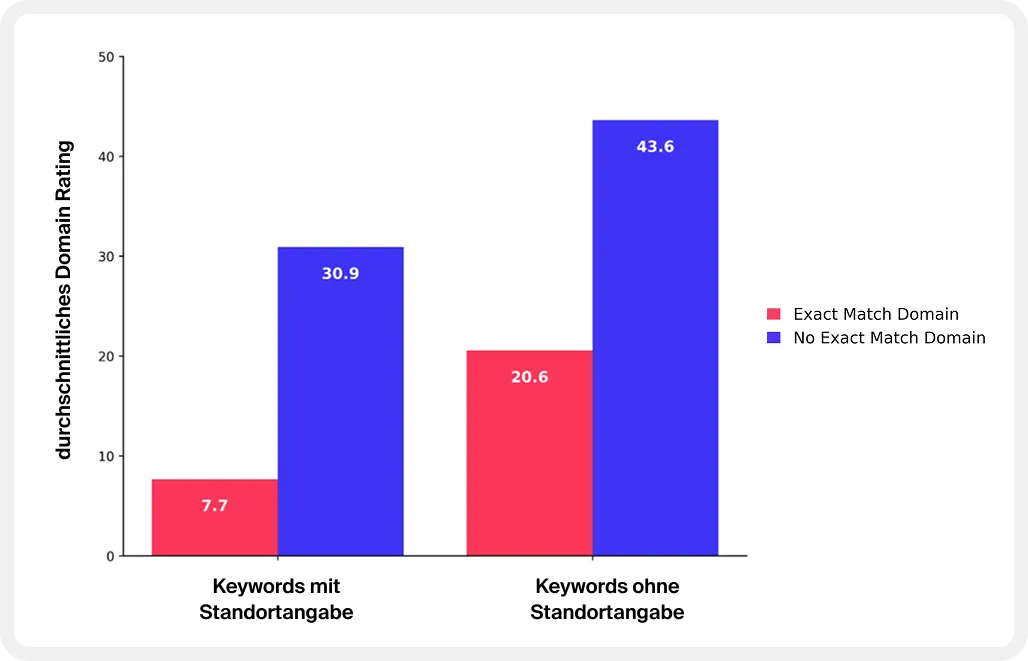
Location-based keywords: This advantage is particularly evident with location-based keywords such as “carpenter Basel.” Here, EMDs rank with an average domain rating of only 7.7, while other domains need an average rating of 30.9 to make it into the top 10. This means that EMDs can rank successfully with a 75% lower domain rating.
Keywords without location information: The picture is similar for keywords without specific location information, such as “camper rental.” Here, the average domain rating of EMDs in the top 10 Google results is only 20.6, while other domains have a significantly higher average rating of 43.6. This means that the domain rating of EMDs is on average around 53% lower than that of other domains.
The following chart illustrates this very clearly and shows how significant the advantage is.
A good example of this effect is the domain campervermietung.ch. It ranks first for the keyword “camper rental,” even though its domain rating is only 8, which is significantly lower than that of its competitors. mycamper.ch in second place has a domain rating of 55, while tcs.ch in third place has an even stronger authority with a rating of 79.

Despite these significant differences, campervermietung.ch ranks at the top of the search results. One possible reason for this strong ranking is that the domain name matches the search term exactly.
Content or keyword: What determines the success of EMDs?
Our analysis shows that exact match domains continue to have a ranking advantage. But the crucial question remains: Is this success solely attributable to EMDs? And what role does content quality play?
To better understand this, we investigated whether EMDs that rank well for their main keyword are also visible for other relevant keywords. The hypothesis behind this is:
- If an EMD ranks well not only for the exact keyword but also for other terms, this indicates that the domain has strong content and that its ranking is not solely due to the domain name.
- However, if an EMD ranks almost exclusively for that one keyword, this could be another indication that keyword matching in the domain name plays a significant role in the ranking.
Results of the analysis
The data paints a clear picture: 70% of the EMDs examined with rankings for their main keyword hardly rank for other relevant keywords.
This means that these domains are almost exclusively visible for the one keyword that exactly matches their domain name – and achieve little organic reach beyond that. This is another strong indication that the EMD itself has a significant impact on the ranking.
At the same time, a sample analysis of the content shows that many of these domains do offer high-quality content tailored to user needs. So there are hardly any cases in which a site with weak or inferior content is pushed up in the rankings solely because of an EMD.
Example: Campervermietung.ch
This can be illustrated using the aforementioned example of the keyword “camper rental.” The website campervermietung.ch ranks first, even though it has a significantly lower domain rating than its competitors mycamper.ch and tcs.ch. This suggests that an exact match between the domain name and the search query is a strong ranking signal.
However, a comparison of the content reveals that campervermietung.ch not only benefits from EMD, but also impresses in terms of content. The website responds well to users' search intentions and offers a large number of motorhomes and campers for rent.
This leads to the following conclusion:
- The EMD provides a clear advantage, as the domain ranks highly despite its lower domain rating.
- Content remains crucial, as high-quality content is necessary to fully leverage the EMD advantage.
Additional considerations
Of course, there are other factors that may explain why EMDs appear so often in the top search results.
The match between the keyword and the domain may make EMDs appear more relevant and trustworthy, leading users to click on them more often. A higher click-through rate could have a positive effect on rankings, which would partly explain the advantage of EMDs.
In addition, backlinks to EMDs have a natural anchor text advantage: links often automatically contain the main keyword, which further strengthens the relevance for this term and can positively influence rankings for the keyword.
These aspects were not analyzed in detail in our study.
Conclusion: EMDs offer advantages, but content remains crucial
Our study shows that EMDs can continue to be a strong ranking signal, but they do not guarantee sustainable success. Especially with local and highly focused keywords, you can benefit from better rankings with a lower domain rating.
However, content remains crucial: the pages examined were convincing not only because of their domain names, but also because of their relevant and well-prepared content. This suggests that while the domain name can be an advantage, it is not a reliable success factor without substantive content.
At the same time, EMDs are not the best choice for every company. If you want to expand your offering or cover multiple locations, you should opt for a brand domain, which is more flexible in the long term.
Recommended actions
In addition to our analysis, we also conducted a survey with various SEO experts about their experiences with EMDs. Their assessments largely confirm our findings. Here are the most important takeaways:
- NUse EMDs specifically for local and specialized offerings: Both our analysis and feedback from experts show that EMDs can be particularly beneficial for clearly defined offerings and local businesses. An EMD signals relevance and can strengthen trust, which can have a positive effect on your click-through rate. This offers a valuable advantage, especially for small, locally based businesses.
- Consider your future plans: The experts surveyed agree: EMDs often offer little room for growth. They work well as long as the offering is clearly focused on a single product or service, but if you want to expand your portfolio later on, you will quickly reach your limits. An example from the survey: If you use a domain such as weightedvest.com, you can cover all subcategories related to this topic, but as soon as other fitness products are added to the range, the domain becomes inappropriate. In this case, a brand domain may be the better choice in the long term.
- Focus on strong content rather than just the domain: All experts surveyed agreed that an EMD alone is not enough. High-quality content, a good user experience, and trust signals such as customer reviews are crucial. If you rely solely on the domain without offering relevant content, you will not be successful in the long term.