Blog introductions: How to write compelling introductions – including examples
Blog introductions: How to write compelling introductions – including examples
Here is an introduction to the topic of content marketing strategy:
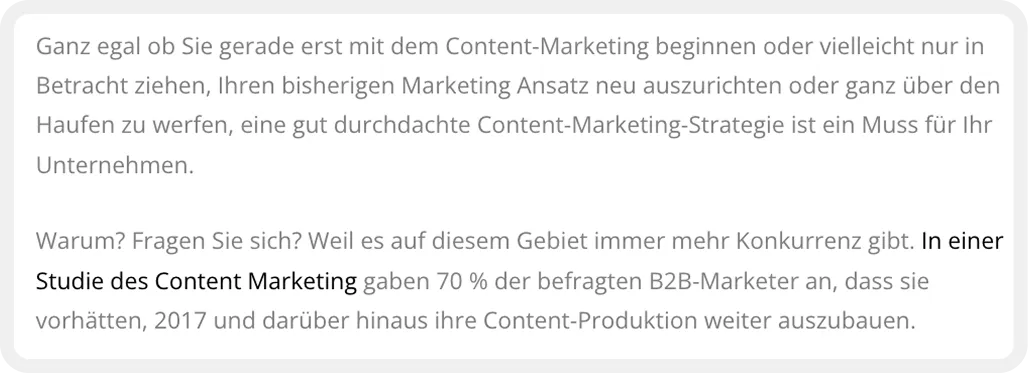
And here is a second introduction on the same topic:
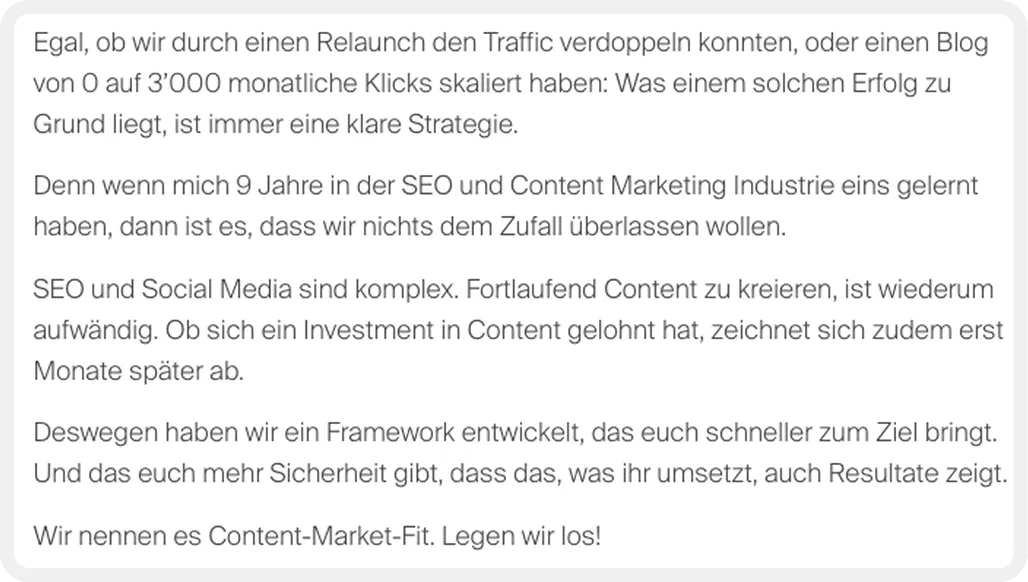
Which is better? A or B?
Before we answer that question, we should perhaps briefly define the criteria for a good introduction or intro. What does a good intro need to do? It needs to inspire users to read on! But what makes someone want to find out more about a topic?
One thing is clear: after the headline, the intro is the most important element of your content piece and must be immediately compelling. It must arouse curiosity, prepare users, give them insights into what follows in the main section and engage them emotionally. Phew, that's quite a lot. And you only have a few sentences to do it. This makes it all the more important that we take a look at what makes a good intro today. Let's go!
Criteria for a good blog intro
An intro must be captivating. You can achieve this if your intro:
- addresses a problem, desire or vision,
- arouses interest and builds suspense with a story,
- makes the author appear credible and competent,
- promotes a unique perspective, new information or benefits.
Let's go back to the two introductions I showed you at the beginning. Let's consider which one meets these criteria...
It should quickly become clear that intro B) is the better introduction. It addresses the target audience directly about their pain points, presents a clear perspective and hooks the reader with a catchy line rather than platitudes or boring definitions. But time and again, we see introductions that are similar to the first example. They read as if a teacher had assigned a student to write an essay.
You know what I'm talking about. Introductions that sound something like this: ‘Football is a sport in which two teams play with a ball. It is one of the most popular sports in the world. Football originated in England...’ Even a fifth grader would fall off their chair out of boredom here.
And it's even worse when we want to reach well-informed consumers or customers in B2B who have 10 or 20 years of professional experience. The CTO of a software company doesn't need an introduction to what cybersecurity is and why it's important for his company. He needs more detailed information on topics at his level.
Build suspense and communicate credibly. You have to earn the attention of your users. The fact is: your users don't want an encyclopaedia article. They don't want an essay. They don't want boring blah blah blah. They want excitement. They want to be drawn into a story. A story that makes promises and keeps them. And I'm going to show you how to do that now.
How to write an excellent introduction in 5 steps
Step 1: Keep your target audience in mind
Who are you writing for, and who are you not writing for? You need to find out exactly what prior knowledge your target audience has and what users already know. Where is your target audience in the funnel? Depending on what stage of the customer journey they have already completed, they will have a different level of knowledge and need different information.
Step 2: Choose a format
Think about which format suits your topic. Should the intro contain an analogy, refer to a personal experience or include existing data? The format determines whether the intro fits the headline and whether the following content will be read. If your users approach the text with different expectations, they may be disappointed.
Step 3: Write an outline
The cursor is blinking. You're trying to write a clever paragraph. Several attempts later, you're still dissatisfied. Don't worry: you're not alone. Experienced writers therefore write the intro at the end, when the rest of the article is finished. Start with a briefing or a rough outline of the article. Even if you are writing the text yourself. This gives you a common thread and lets you know where the focus of the text should lie. And then, when the text is finished, write the introduction. This way, you avoid the introduction missing the mark with the rest of the content.
In summary
- What exactly do you want to communicate and, above all, how do you want to reach your users?
- What must be included, and what is out of scope for your users? Remember: you are probably much more knowledgeable about the topic than your users. Therefore, you must always speak the language of your target audience.
- How can you capture and hold the attention of your target audience? What makes your article unique? What new insights are you communicating? The bestseller ‘Made to Stick’ by authors Chip Heath and Dan Heath can be a great help here. Check it out!
Step 4: Write the first draft
Once you have drafted the outline and text, it's time to write the introduction. As mentioned above, you should already have a rough draft of the text ready. This has the following advantages:
- The intro will work better: The introduction serves to set the scene. It indicates what will be communicated in the article. Without knowing exactly what the content is beforehand, it will be difficult to write a good intro.
- You avoid editing trauma: You've put a lot of time and energy into writing the intro, and then it doesn't fit well with the content. This can be very frustrating. You change the intro and still can't find the common thread. You can avoid this by writing the intro at the end.
- No writer's block: Every beginning is difficult. Once you've done that, the rest of the text will flow naturally. By focusing on the body text first, you'll make faster progress and won't waste a lot of time on the introduction. This will make it much easier for you in the end.
{{blog-cta}}
Step 5: Edit and shorten
Be brave and feel free to delete the first few sentences from your intro. It may take some effort, but you'll find that this helps you get to the point more quickly and prevents users from getting bored and leaving. The intro should really just briefly summarise what is elaborated on at length in the content. So don't waste your users' valuable time and keep it short.
If you notice that something doesn't add to the excitement, leave it out. Also, avoid rhetorical questions such as ‘Do you want to know how to write a good intro?’. Of course your users want to know, otherwise they wouldn't be there. Such unnecessary questions can quickly have a deterrent effect and scare users away.
Compelling introduction: 4 examples
1. Persönliche Erfahrungen
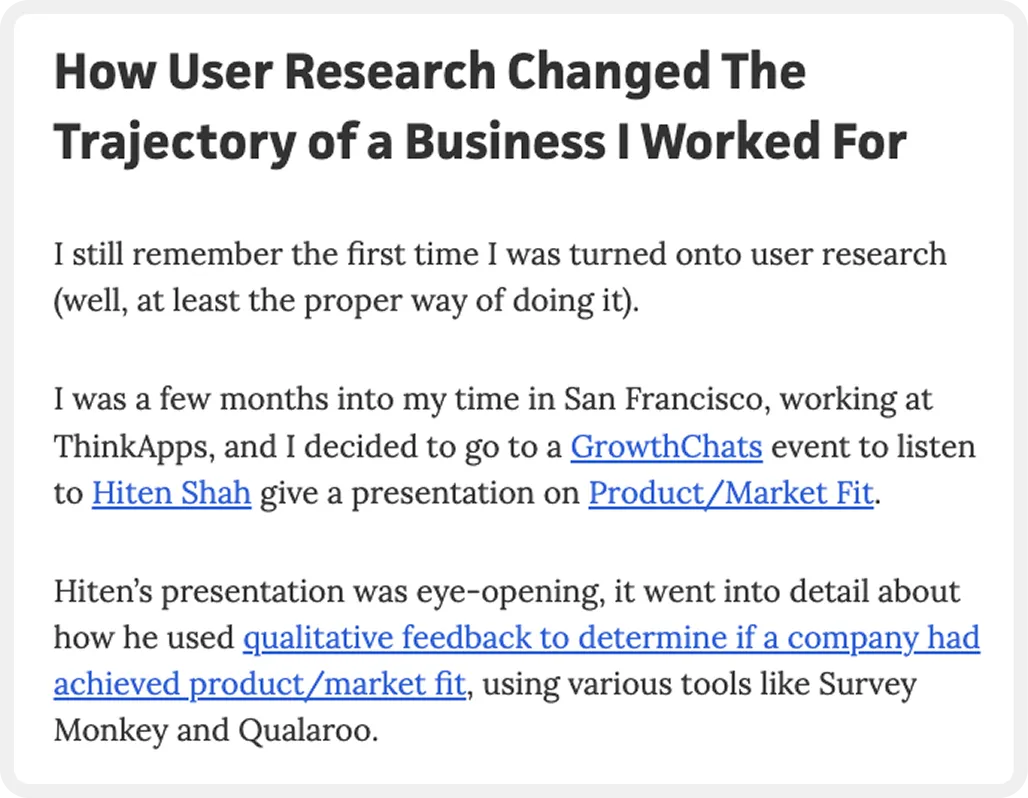
Feel free to start your articles with stories or narratives. The more personal they are, the more likely we as readers are to identify with the story. For example, one such topic could be an event that inspired you. Or someone asked for a recommendation or made a strange comment.
Whatever it is, these personal topics not only give the author more credibility, but also ensure that you engage users on an emotional level.
Benji Hyam, for example, recounts a personal experience. He was at a conference and heard a speech by Hiten Shah. This inspired him, as he tells us here:
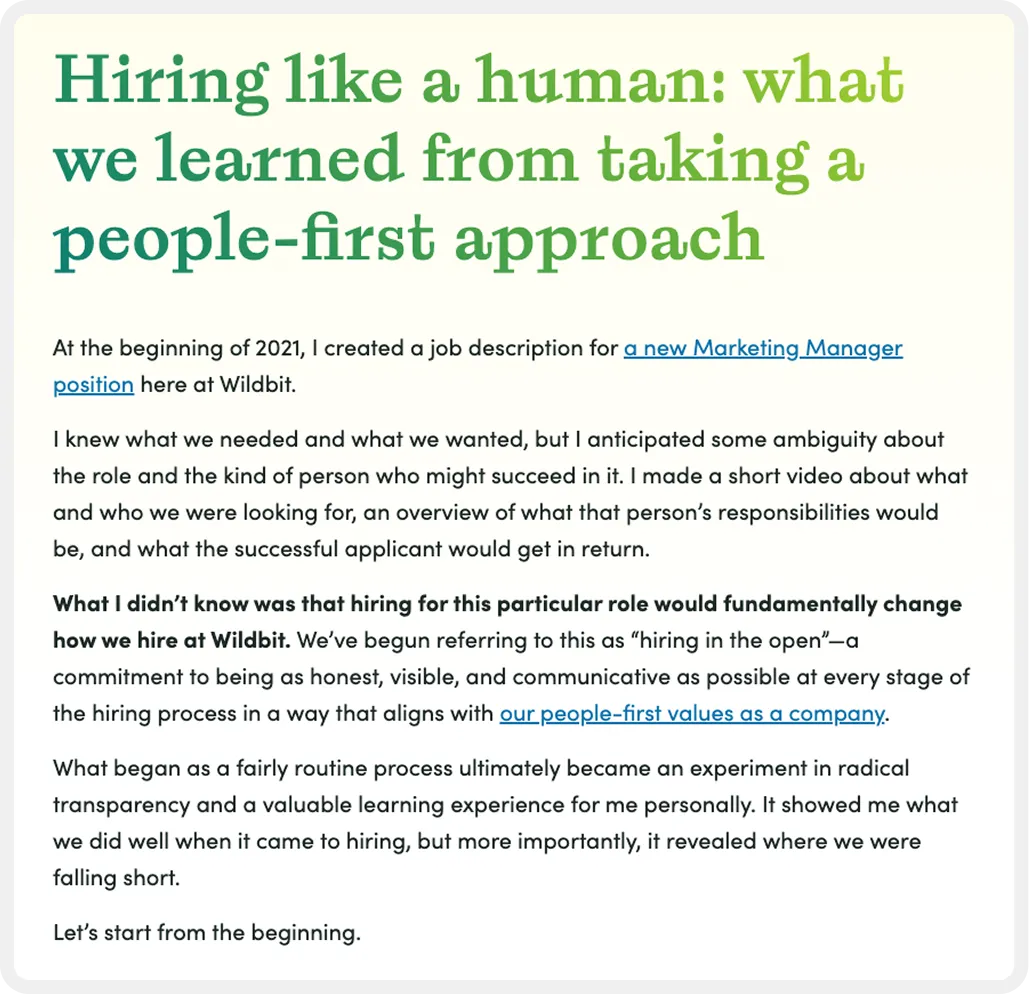
The following example shows how content marketers learn from their own experiences. Wildbit recounts how they advertised a job themselves and what insights they gained as a result. This could also be an example from a book, video or film – depending on where your idea comes from:
The following intro is a great example of a personal introduction. Fio Dosetto talks about her early days at Hotjar and teases that her learnings will follow in the post:

Keep your eyes open! An everyday discovery can also serve as a hook for your article. As in this example:
2. Analogies
Analogies create a sense of belonging. Do you see parallels between a current topic and another topic? Great. Write an article about it and use this analogy as your introduction. Introductions like this serve two important purposes:
They stand out because they immediately grab the reader's attention and make them want to read on. But they also create a framework that puts the rest of the article into context. The analogy makes the topic of the article easier to understand and provides a new perspective that in turn inspires your users.
- In this article, Ryan Law explains how starlight relates to Google's current search results. This analogy immediately piques users' curiosity.
- This article lists a number of speed records. This also attracts attention because it makes you wonder what this could have to do with sales. Later, a comparison is made with the speed pipeline. The message: speed matters!
- To write an intro, you need a good hook. This has been implemented in this article as an example – with an analogy to sport fishing.
- Everyone knows Archimedes and his idea of ‘leverage’. This article includes a fitting quote in the introduction and transitions to entrepreneurship.
3. Facts and Figures
Let the facts speak for themselves! Nothing is more interesting to your users than hard facts and figures on a specific topic. These can be difficult to research and are usually based on your individual experiences. You can use them, for example, to underpin the relevance of your niche or to raise user awareness of a topic.
But don't forget: the facts and figures should be relevant to your topic (and much more closely related to your point of view than in our example A above).
Here we see how Appcues uses Slack's revenue figures to illustrate the impact of product acceptance on a company's bottom line.

4. The PPB Formula
This formula stands for Preview Proof Benefit (PPB) and is a copywriting formula developed by Brian Dean, which he often uses in blog introductions to consistently grab users' attention. We often use it ourselves when writing content for ourselves or our customers.
The formula ensures that users spend more time on your website. But: You also have to really deliver in the article and provide added value.
- The first P stands for preview. This shows users what they can expect in the upcoming article and why they should read it.
- The second P stands for proof. Why should your users trust what you say in the article? Prove that you know what you are talking about.
- The B stands for Benefit, i.e. the benefit that users will gain from reading your article. What will they get out of it in the end? What will they be able to do thanks to your article? These factors are important for users to know that it is worth reading on.
[[callout]]
Example:
"Have you always wanted to know how to write perfect introductions that not only convince your readers but also make them curious? We have already written articles and introductions for many of our customers that have ensured that the target audience reads the article with excitement – right to the end. This has increased the length of stay enormously! In the following article, we'll show you how you can write a captivating intro yourself in 5 simple steps that will immediately draw your readers in."
[[callout end]]
I hope I've been able to give you some inspiration for your next intro. And if you've read this far, you know how powerful an intro can be.