
Programmatic SEO: How Textshuttle doubled its organic traffic despite fierce competition
Programmatic SEO: How Textshuttle doubled its organic traffic despite fierce competition
If you've ever translated a text online, you're bound to have come across DeepL or Google Translate. These two giants dominate the translation market – technologically, financially and in organic search.
And it was precisely these heavyweights that we took on when we developed an SEO strategy for the Swiss start-up Textshuttle.
[[callout]] About Textshuttle
Textshuttle is a Swiss start-up founded at the University of Zurich. Since 2017, it has been developing AI-supported translation technologies that are used by large Swiss companies and public authorities.
[[callout end]]
Initial situation: Reaching a new target group with a limited marketing budget
Textshuttle had a clear goal in 2023: In addition to large companies, it also wanted to target individual translators and SMEs. Although this target group is large, each customer has a limited marketing budget. Accordingly, the customer acquisition cost (CAC) had to be significantly lower than that of paid channels.
Textshuttle therefore opted for a product-led approach and made the translation tool available to the public for the first time on its website. Technically, everything was ready – and SEO seemed to be the ideal channel to generate reach for the AI translator. Although visibility increased slightly, the hoped-for traffic failed to materialise. That wasn't enough for Textshuttle.

The challenge: the homepage as a bottleneck
Our initial analysis quickly revealed the cause: since the AI translator was located on Textshuttle's homepage, Textshuttle was also attempting to rank the homepage for virtually all relevant search queries at the same time.
From an SEO perspective, the homepage is usually the strongest page on a website. However, its capacity to cover different search intentions at once is limited.
The result: although the tool supported dozens of language combinations, the site did not rank for these combinations. It lacked individual, indexable URLs with specific content.
{{blog-cta}}
The solution: fragmented programmatic pages
Instead of further overloading the home page, we therefore took a completely new approach and created specific sub-topics and clusters:
1. Data from Google Search Console
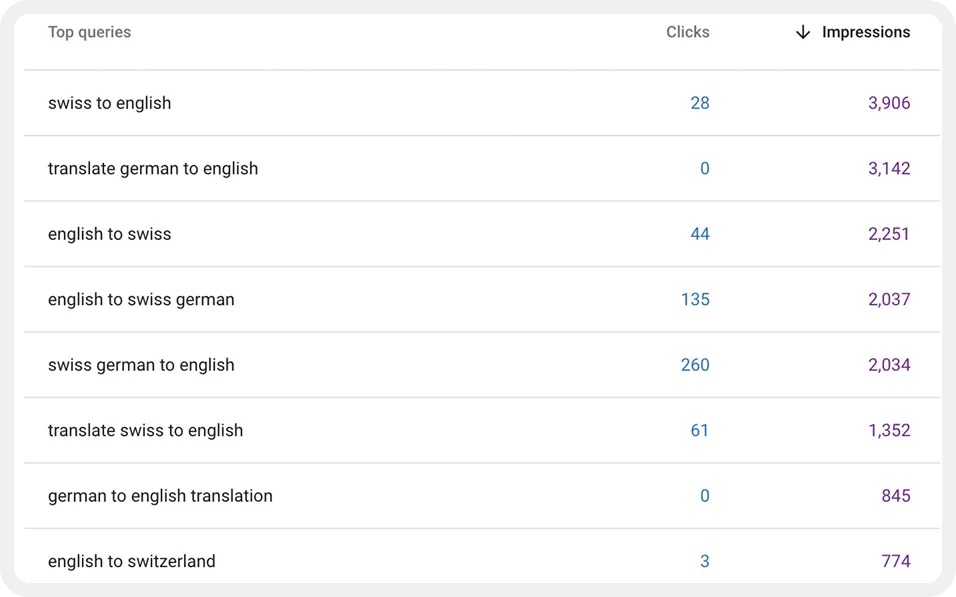
We started by analysing data from Search Console. There, we identified language pairs with many impressions but low click-through rates – a clear sign of missing or inappropriate content.
2. Keyword clustering based on long-tail search terms
When clustering hundreds of long-tail keywords, we noticed a clear pattern: language combinations such as ‘German to English’ or ‘English to German’ had many impressions, but also very low rankings and therefore few clicks.
Although these language pairs were available on the homepage, Google did not perceive the site as relevant for the corresponding search queries.

The reason: lack of context! Google still primarily uses the text content of a page to evaluate its relevance to a search query. If important terms such as ‘German to English’ and topic-relevant information are missing, it is unlikely that Google will consider the page relevant enough for this search query, as the search intent is not sufficiently served.
3. Specific pages per language combination
As a result, we created programmatic landing pages using a uniform template. The pages resembled the structure of the homepage, but were tailored to a specific language combination. They contained the translation tool, preconfigured for the respective language pair, and supplementary content blocks with appropriate terms and contexts.
Although this is not a purely programmatic SEO strategy, the template-based approach enabled us to quickly launch many targeted pages in multiple languages.
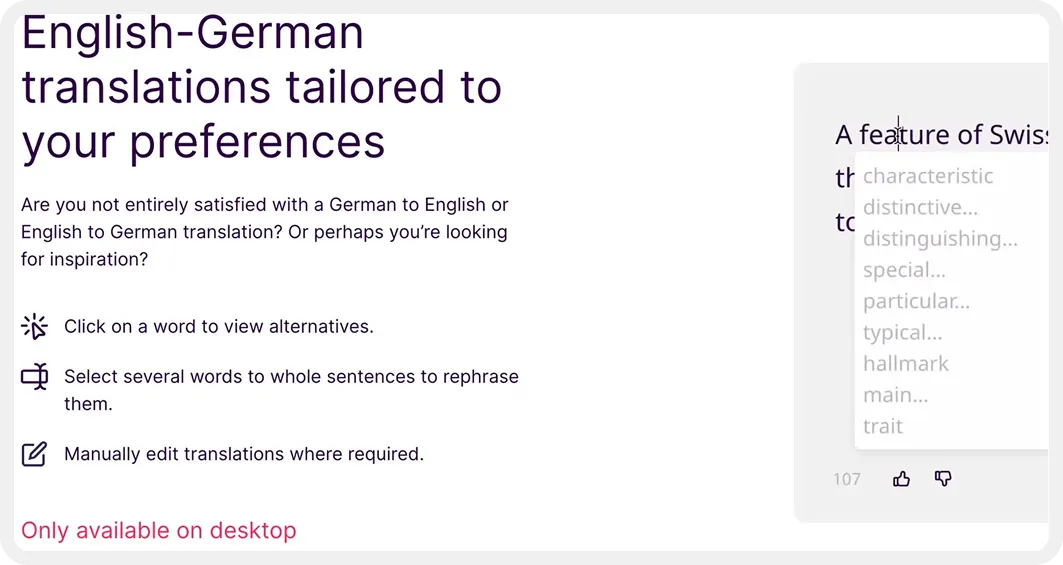
Shortly after launch, the new pages began to rank. Traffic shifted from the homepage to the new landing pages.
Technical optimisations as the basis for sustainable visibility
To ensure that the newly created pages had the best chance of achieving a top ranking, we analysed the entire technical crawl and indexing process. By following the Google bot journey, we uncovered critical weaknesses in crawling, rendering, indexing and ranking, and eliminated obstacles in rendering, sitemaps, hreflang and JavaScript playback.
A deep dive into all SEO measures would go too far here – the bottom line is that even the best content is useless without clean technology.

Local relevance as a lever for high-quality backlinks
With DeepL as one of its main competitors, Textshuttle found itself in a classic David versus Goliath situation. In a direct comparison, Textshuttle had one particular weakness: less authority. To catch up more quickly, we had to find creative ways.
So we developed a targeted link-building tactic that used DeepL's success as a springboard, emphasising Textshuttle's local relevance.
At that time, many Swiss media outlets and universities with high domain authority were linking to DeepL. However, as a Swiss company focusing on Swiss German and Romansh, Textshuttle was significantly more relevant to their target groups.
With this argument, we were able to gain numerous high-quality links – without classic PR campaigns or high costs.

The Result
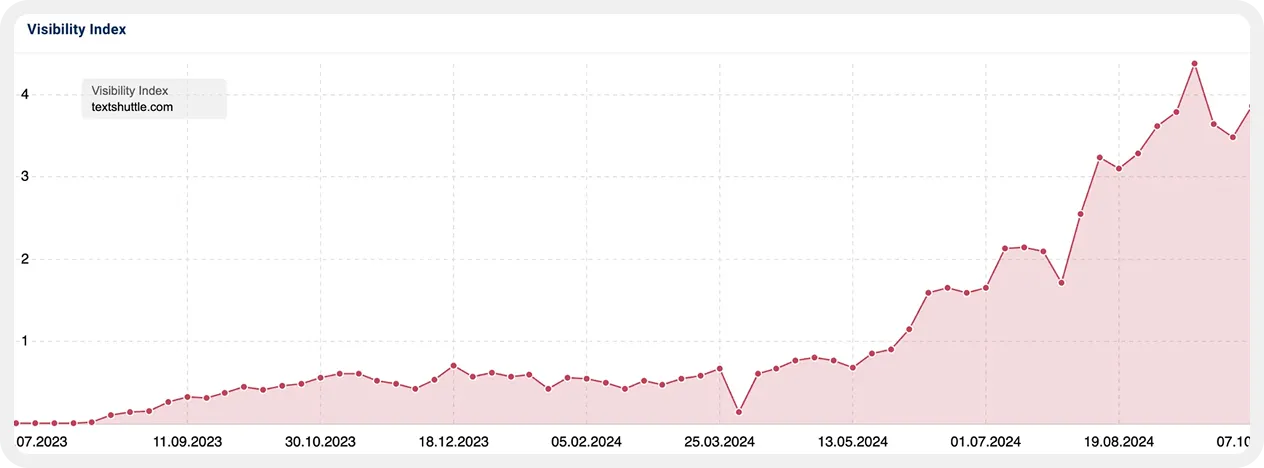
The combination of specific landing pages, technical optimisations and targeted link building quickly showed results: visibility has increased tenfold since the start of the collaboration.
Organic traffic has also doubled within a short period of time.
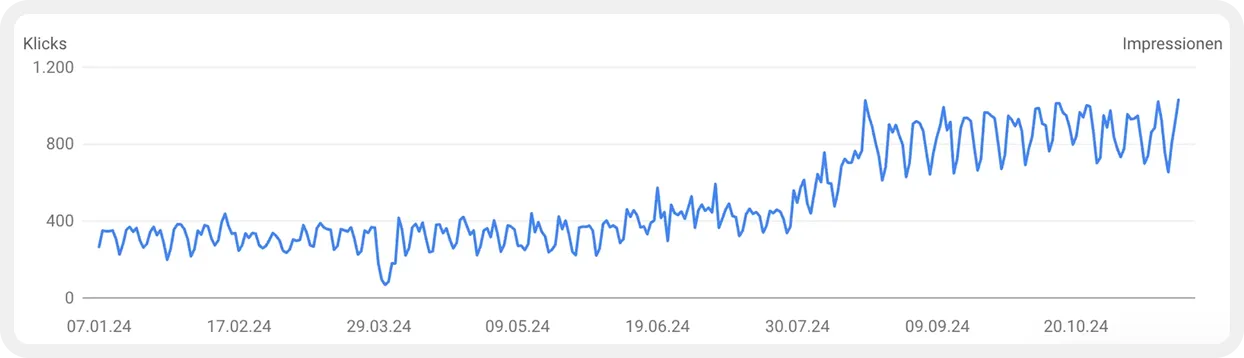
With these results, we even exceeded our initial expectations and forecasts by a considerable margin – much to the delight of our client and ourselves.
"As COO, I had limited time for marketing. The fact that we were able to achieve such results in such a short time is not a matter of course and is thanks to the uncomplicated cooperation as well as Digital Leverage's expertise and hands-on approach." – Simona Todesco, then COO of Textshuttle (now COO of Supertext)
[[callout]]
Note: Textshuttle has since merged with the translation company Supertext. Together, we are now developing an SEO strategy for supertext.com.
[[callout end]]
Next steps: Write your own success story
1. Stand out from strong competitors with specific, relevant content
Even smaller websites have a good chance of standing out from larger competitors if they target specific use cases with long-tail keywords and thus better fulfil the search intent than the competition.
2. Remove SEO barriers and obstacles
While creating websites is becoming increasingly easy, the same cannot necessarily be said for optimising the backend. If you don't make sure that Google (and now also LLMs) can process your website without any problems when (re)launching it, you run the risk of all your content initiatives coming to nothing.
3. Actively use local competitive advantages and partnerships for link building
Links from pages with high domain authority remain a crucial ranking factor. If your website has only a few high-quality backlinks, it is difficult to compete with strong competitors. That's why we integrate link building and digital PR as an integral part of many projects for start-ups and scale-ups.
[[callout]]
Would you like to increase your visibility, reach and leads through SEO and content? Contact us for a no-obligation consultation or hands-on support.
[[callout end]]